
Your pre-roll line stops 6 times per shift for jams.
That “one big box” sounds great until it becomes the only thing standing between you and ship dates.
Cannabis MSOs feel this pain first. You run more SKUs. You run more strains. You run more facilities. You also run into more audits, more new hires, and more “we need 40,000 units by Friday” moments. When an all-in-one pre roll machine goes down, the whole workflow goes down with it.
That’s why you’re seeing more Cannabis MSOs split the workflow back into purpose-built stations. Grind. Fill. Weigh. Close. Same tray. Less drama.
All-in-one cannabis machines turn one fault into a full stop
All-in-one cannabis machines bundle grinding, weighing, filling, and closing into one structure. One fault stops everything. That isn’t a theory. It’s how the system is built.
Now put MSO volume against that risk.
RocketBox Pro output lives in the 2,400 to 2,800 cones per hour range on 1-gram SKUs for many operators, with a stated max of 3,000 per hour.
If you lose 45 minutes to a jam, sensor issue, or deep clean, you lose about 1,800 to 2,100 pre-rolls right there.
Use a simple wholesale example: $3 per unit contribution after packaging and labor.
That single 45-minute event costs $5,400 to $6,300. One time. Not a whole week. Just one unplanned stop.
Here’s the part that makes MSO operators roll their eyes. In an all-in-one setup, the fix rarely stays in one area. You open panels. You pull parts. You clean material out of places it should never reach. Then you run test cycles to confirm weights and density again.
Modular setups isolate the blast radius. If your closer has an issue, your grinder still preps material. If your filler needs attention, your QA team can still weigh yesterday’s run and clear batches.
Changeovers and cleaning punish Cannabis MSOs harder than anyone
Cannabis MSOs don’t run one hero product all day. You run 0.5g, 0.7g, 1g. You run a dogwalker line for one state and king cones for another. You run strain rotations because sales wants fresh drops every week.
All-in-one cannabis machines slow changeovers because material spreads across multiple subsystems. Cleaning one section often turns into opening the whole unit.
RocketBox Pro teams often complete strain changeovers in 20 to 30 minutes with trained staff, and facilities running 6 strains per day can keep total changeover time under 3 hours.
That number matters because it’s real production time you get back, not a brochure fantasy.
Here’s a quick line-floor example.
A production manager told me their old all-in-one machine “ran fine” until they added 4 more SKUs. After that, the machine spent more time being cleaned than being fed. The crew started joking the machine took more breaks than they did. It was funny for a week. Then sales started calling.
Modular workflows win here because you swap what needs swapping. Trays, screens, contact parts. You don’t tear down your whole line to change one variable.
Compliance and QC need checkpoints, not a black box
Cannabis MSOs live under a microscope. Internal QA. State auditors. Retail chargebacks. Wholesale partners rejecting lots over weight drift.
In an all-in-one pre roll machine, QC often becomes a scramble at the end. You find out too late that weights drifted. Then you’re stuck with top-offs, knock-downs, and rework.
A dedicated weighing station fixes that workflow problem.
LaunchPad Scale is built to weigh up to 72 pre-rolls at once, with a color-coded display that flags rejects and lets you set target weights and tolerances.
That changes your day. Your QC team stops sampling 10 units and hoping the other 9,990 are fine.
It also keeps batch conversations clean. You can pull a tray, verify weights, and either clear it for packaging or kick it back for rework before it contaminates the whole schedule.
One detail Cannabis MSOs can’t ignore: LaunchPad is listed as not NTEP certified, and state requirements vary, so your team needs to check your local weights and measures rules.
That’s not a deal-breaker. It’s just part of running in multiple states.
Modular cannabis machines scale by adding stations, not replacing systems
All-in-one scaling usually looks like this:
- Buy a second identical unit
- Or replace the whole system
That’s a hard conversation in capital planning. You’re paying for duplicate features you don’t need, and you’re eating floor space fast.
Modular scaling looks more like manufacturing. You add horsepower where the bottleneck lives.
Start upstream. Revolution 2.0 grinder planning numbers sit at 15 to 30 pounds per hour with flower at 7 to 10% moisture, and facilities plan up to 400 pounds per day with the right staging.
If grinding stays steady, your filler stops getting babysat.
Then you scale filling based on demand.
RocketBox Pro calls out up to 3,000 pre-rolls per hour, and manual crews averaging 120 cones per hour per worker need 20 to 25 employees to match that output.
That’s the clearest labor comparison MSO finance teams care about. Heads count. Training time. Turnover.
The RocketBox Pro page also gives a straight ROI example: at 2,600 cones per hour average output, 14 production hours per day, 5 days per week, and a labor reduction of 15 employees at $18 per hour fully burdened, annual labor savings exceed $280,000. It then stacks material recovery math that can push total impact past $1 million annually for high-volume operators.
That’s why modular is showing up more in MSO buildouts.
You don’t “bet the plant” on one machine. You build a line that grows in pieces.
What a Cannabis MSO ready tray workflow looks like on the floor
The cleanest version is a tray workflow where each station does one job, then hands the tray forward.
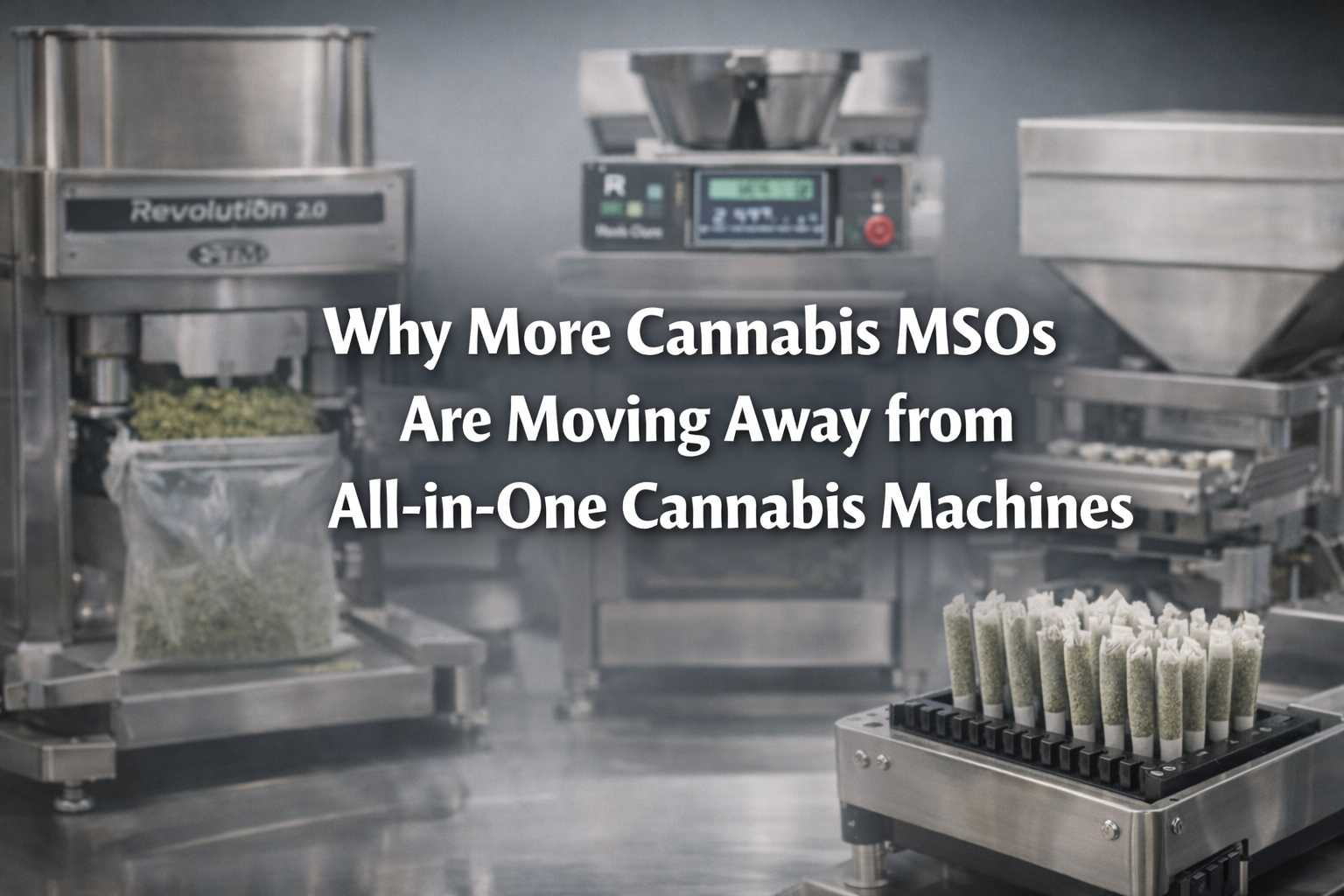
- Grind: Revolution 2.0 sets particle size and keeps output steady at 15 to 30 pounds per hour planning numbers.
- Fill: RocketBox 2.0 fills and packs 72 to 453 cones per cycle, runs 84mm, 98mm, and 109mm formats, and uses smart density control.
- Weigh: LaunchPad weighs up to 72 at once and flags out-of-tolerance units fast.
- Close: Atomic Closer Turbo calls out up to 4,250 joints per hour, with a 72-count cycle callout and size support from 70mm through 109mm.
If you’re building a smaller room or a new market launch, Mini-RocketBox Plus+ also gives a very practical throughput marker: up to 143 pre-roll cones in 30 to 45 seconds.
That’s a real bridge between hand-packing and MSO-scale output.
This modular layout also travels well across geographies. STM calls out support for licensed facilities across legal markets including California, Colorado, Michigan, Oregon, Washington, Nevada, Arizona, plus Ontario and British Columbia.
Cannabis MSOs don’t need a different philosophy per state. They need a workflow that survives different SKUs and staffing.
Four quick questions Cannabis MSO teams must answer
1) Are all-in-one pre roll cannabis machines ever a good fit?
Yes, for stable SKUs and fixed volume targets where changeovers stay rare. Once your SKU count climbs, the all-in-one cleaning and downtime tradeoffs get expensive fast.
2) What’s the fastest way to spot the real bottleneck?
Look for the step that forces overtime. If closing backs up trays, add closing capacity. If weights drift and QC keeps holding lots, add weighing capacity. Modular scaling targets the real constraint instead of buying a whole second all-in-one box.
3) What throughput numbers matter more than headline speed?
Changeover time and rework rate. RocketBox Pro lists 20 to 30 minute changeovers for trained teams, and it ties output to real staffing math. Those two numbers predict schedule control better than a peak-cycle claim.
4) How do you explain the ROI to finance without hype?
Use their language: labor dollars and material giveaway. RocketBox Pro publishes an ROI example that shows labor savings above $280,000 per year, plus material recovery math that can push total impact past $1 million for high-volume operators.
Specific next step: calculate your all-in-one cost per day
Run this on your last 2 weeks of production logs:
Daily line cost =
Rejected units per day × grams per unit × internal cost per gram
Plus rework labor hours × loaded wage
Plus downtime minutes × units per minute × contribution per unit
You don’t need perfect inputs. You need honest ones. Once you see the daily number, the next move gets obvious. Add a station. Split the workflow. Stop letting one machine control the whole schedule.