

Pre-roll buyers talk about “cones” like they’re all the same. Operators know better.
A 0.5g dogwalker and a 2g infused blunt do not behave the same on a line. They don’t pack the same, they don’t settle the same, and they don’t pass the same QC checks. Even the same flower runs different once you change paper, tip, or grind.
If your team sells multiple pre-roll types, you’re running a product mix problem. That problem shows up as labor, rework, and missed batch targets.
Canna cones 101: the cone is the container, the pre-roll is the product
“Canna cones” usually means a pre-rolled paper cone with a filter tip already set. You fill it, settle it, close it, and label it.
From a brand angle, cones feel premium. From a production angle, cones are a spec sheet.
A few specs drive most of the headaches:
- Weight target: 0.35g, 0.5g, 0.75g, 1g, 2g
- Paper material: white paper, brown paper, hemp
- Tip style: paper tip, wood tip, cotton filter
- Shape: straight joint, cone, blunt
- Infusion style: none, internal blend, external coat, center “donut”
Every change hits your standard work.
Here’s a simple way to price the impact.
Rework cost formula:
Daily rework minutes × labor rate per minute + daily scrap units × material cost per unit
Example numbers that feel real on most lines:
- 60 minutes of rework per day
- $22 per hour fully loaded labor cost
- 300 scrapped units per day
- $1.10 average material cost per unit
Math:
- Labor: 60 min × ($22 ÷ 60) = $22 per day
- Scrap: 300 × $1.10 = $330 per day
- Total: $352 per day, about $7,040 per month on a 20-day month
That’s one product mix problem, not a “bad day.”
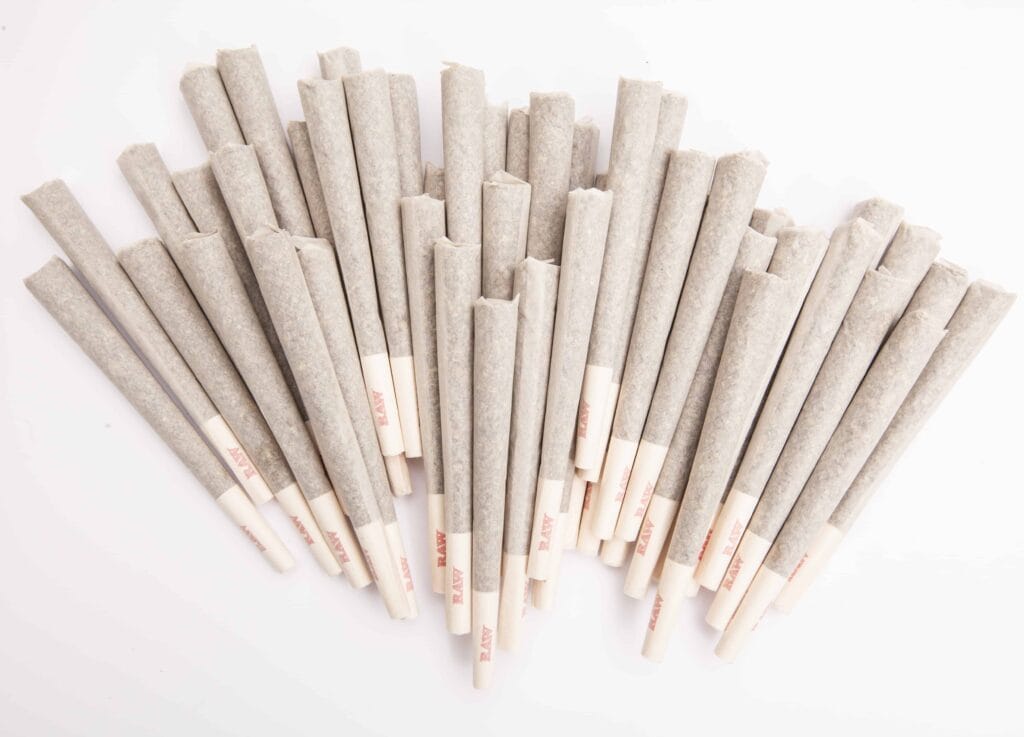
Type 1: Classic flower pre-rolls
This is the base of the category. If this SKU runs clean, the rest of your lineup gets easier.
Straight joints
Straight tubes look simple. They pack simple too, if the grind is consistent and the moisture stays in range. They also tend to show channeling if your fill is uneven.
Most straight joints land in the 0.5g to 1g range. That’s the sweet spot for multipacks and value drops.
Operational note: straight joints punish sloppy closing. A loose twist looks cheap and fails drop tests fast.
Cones
Cones hide sins. That’s why brands love them. The wider top gives you more room for fill variation, and the taper helps the close look clean.
Cones also create a settling problem. Product shifts during handling. You see it as headspace at the tip, then a tight draw complaint later.
A simple QC check that catches this early:
- Weigh pre-close
- Tap settle step
- Reweigh random samples every 30 minutes
If your delta creeps, your fill method or grind changed.
Mini and dogwalkers
Small cones sell fast. They also bring the highest “percent error” pain.
If you target 0.35g and your process drifts by 0.03g, that’s almost 9% off target. That swings cost, compliance, and customer trust in one move.
Small SKUs need tighter weigh control and tighter settle control. Your packaging team also feels it, since minis spill easier during tray moves.
Type 2: Infused pre-rolls
Infused pre-rolls print margin, then steal it back if the process is messy.
Infusion changes stickiness, flow, and burn. It also raises the compliance stakes. Your batch records and weights need to line up clean.
Mixed infusion
This is flower blended with distillate, live resin, or other concentrates.
Production reality:
- Blend clumps form
- Cones bridge or jam
- Rejects rise during fill
Your team ends up doing “hand saves.” That feels like craftsmanship. It’s rework.
A line habit that helps:
- Set a blend window, like 30 to 45 minutes
- Re-mix on a timer
- Pull a quick sieve check when the feel changes
Coated or dipped
These look great on Instagram. They also create handling issues.
Coated SKUs can stick to trays, stick to gloves, and smear onto packaging. That means slower packout and more wipe downs.
Plan on longer changeovers. If your normal changeover is 20 minutes, coated SKUs often push 35 minutes because every contact surface needs a clean reset.
“Donut” and “hash hole” styles
This is flower around a concentrate core.
They sell. They also demand process discipline:
- Centering the core
- Keeping the core stable
- Preventing blowouts during close
If the core shifts, you get hot spots, bad burns, and returns. Returns cost more than scrap because they hit your reputation.
Type 3: Wrapped styles, papers, and filters
Buyers call this “preference.” Operators call it “variance.”
Paper choices
White papers burn fast and clean. Brown and hemp papers burn slower and feel “natural” to a lot of shoppers.
Paper changes airflow. Airflow changes draw. Draw changes the review score.
If you run the same fill weight across 2 paper types, expect a different smoke. That leads to “same strain, different experience” complaints.
Blunts
Blunts push larger weights, often 1.5g to 2.5g. They also push higher terp loss risk if you hold WIP too long.
Blunt wraps also cost more per unit. That increases your scrap penalty.
Example:
If your blunt material cost is $2.10 per unit and you scrap 150 per day, that’s $315 per day. That’s $6,300 per month on a 20-day month.
Filter tips
Paper tips are cheap and fast. Wood tips feel premium and can reduce “soggy tip” complaints. Cotton filters can change draw and reduce particulate.
Filter changes can force new closing settings. It also changes your case pack fit. That hits your packaging line, not just pre-roll.
Type 4: Multipacks and mixed packs
Multipacks look like a sales decision. They’re also a scheduling decision.
A 5-pack at 0.5g is 2.5g total. That’s easy to plan. A mixed pack with 3 strains creates lot tracking stress.
In states with tight labeling and batch trace rules, mixed packs create more label SKUs, more label checks, more scan points. One missed scan can trigger a hold.
If your brand wants mixed packs, build a real process:
- One lot per slot
- Clear tray ID
- A second-person label verification at packout
That costs labor. It protects revenue.
What this means for the production floor
Every pre-roll type maps to 4 core steps: grind, fill, weigh, close. Your team lives inside those steps all day.
STM Canna built its systems around a modular tray workflow with grinders, cone fillers, automated weighing, and closing devices that work together as a line.
That “work together” part matters when you run variety.
Variety creates handoffs. Handoffs create errors. Errors create holds.
A quick example from real life: your team runs 10,000 units of a 1g cone, then flips to a 0.35g mini. Someone forgets to swap the right tip or the right tray insert. You don’t catch it until packout. Now you have 2 hours of sort and rework, plus a QA hold.
That’s why operators lean toward a setup where each module has a clean role and quick changeover habits. Grinding stays consistent. Filling stays consistent. Weighing catches drift. Closing stays uniform.
That’s how you keep “more SKUs” from turning into “more chaos.”
FAQ: Canna cones and types of pre-rolls
What are canna cones?
Pre-rolled paper cones with a tip, ready for cannabis filling and closing.
What’s the difference between a cone and a joint?
A cone tapers. A joint stays straight. The shape changes how product settles and how the close looks.
What’s the most popular pre-roll size?
Many brands center on 0.5g and 1g because they balance cost, compliance, and customer expectations.
Why do infused pre-rolls cause more rejects?
Infusions change flow and stickiness. That increases clumps, bridging, and inconsistent weights.
Why do minis feel harder to run?
Small weight targets amplify drift. A 0.03g shift hits a mini harder than a 1g cone.
What’s the simplest way to estimate SKU complexity cost?
Track changeover minutes, rework minutes, and scrap units per SKU, then convert it to dollars.
The next step: calculate your SKU mix cost before you add the next “hot” pre-roll
Write down your top 6 pre-roll types. Next to each one, track 3 numbers for 2 weeks:
- Average changeover minutes
- Average scrap units per day
- Average rework minutes per day
Then run this:
SKU cost per month = (changeover minutes + rework minutes) × labor rate per minute × workdays + scrap units × material cost × workdays
The next question is capacity planning for Q3 peaks. Want some assistance? Let’s plan together!