
Commercial production / Cone sizes
Every standard cone size, fill weight, and production consideration — in one reference for cannabis operators.

Understanding pre-roll sizes is the foundation of every commercial production line decision you make. Choose the wrong cone size and you will feel it in three ways: a consumer who finishes in two minutes when they wanted ten, a retail buyer who passes on reorder, and a production line that runs slower than it should because the format does not match the machine. This guide covers every standard commercial pre-roll cone size, the technical specifications that matter for production, how flower density affects fill weight, which paper types perform best at scale, and which STM machines are optimized for each format.
This is written for commercial cannabis operators, not consumers. Pre-roll sizes affect throughput, packaging costs, compliance weight tolerances, and retail velocity. If you are building or optimizing a pre-roll production line, this is the reference you need.
Data sourced from manufacturer specifications and Custom Cones USA 2026 Market Report.

Common Name
Dogwalker / Mini
Fill Weight
0.25 – 0.5g
Opening Diameter
10.2mm
Filter Length
21-26mm
Burn Time
5-10 min
Best For
Solo quick session, multi-packs
STM Compatible Machines
RollCraft MRB Mini RocketBox+ RocketBox 3.0 RocketBox Pro
Common Name
1¼ Classic
Fill Weight
0.5 – 0.65g
Opening Diameter
10.8mm
Filter Length
26mm
Burn Time
10-15 min
Best For
Daily personal use, highest velocity SKU
STM Compatible Machines
RollCraft MRB Mini RocketBox+ RocketBox 3.0 RocketBox Pro
Common Name
98 Special
Fill Weight
0.5 – 0.75g
Opening Diameter
11.8mm
Filter Length
20-30mm
Burn Time
15-20 min
Best For
Mid-tier premium SKU, two-person sessions
STM Compatible Machines
RollCraft MRB Mini RocketBox+ RocketBox 3.0 RocketBox Pro
Common Name
King Size
Fill Weight
0.75 – 1.6g
Opening Diameter
12.5mm
Filter Length
26mm
Burn Time
20-30 min
Best For
Flagship SKU, group sessions, MSO anchor format
STM Compatible Machines
RollCraft MRB Mini RocketBox+ RocketBox 3.0 RocketBox Pro
Common Name
Oversized / Infused King
Fill Weight
1.0 – 2.0g+
Opening Diameter
13mm+
Filter Length
26-35mm
Burn Time
25-40 min
Best For
Infused pre-rolls, hashhole, premium tier
STM Compatible Machines
RocketBox Pro Astro Infuser
Fill weights vary based on flower density and grind consistency. All STM filling machines support the four standard sizes, including the 70mm tray. The RocketBox 3.0 supports 70mm, 84mm, 98mm and 109mm cones, plus custom sizes. Confirm tray configuration with STM. The 109mm+ oversized format is designed for homogenized infused material on the RocketBox Pro.

Two identical 98mm cones, filled to the same visual level, can hold 0.6g of one strain and 0.9g of another. This is not a machine error. It is flower density, and understanding it is the most important technical concept for commercial pre-roll production.

The tobacco industry calls this “filling power” – the measure of how much volume a given weight of material occupies. Fluffy, airy cannabis has high filling power, meaning it takes up more space per gram. Dense, compact flower has low filling power and packs more weight into the same volume. Two producers running the same machine with the same cone will get different output weights if their material density differs.
This matters for three reasons specific to commercial automation:
• Compliance weight tolerances. Most states require pre-rolls to be within a defined weight variance of the labeled gram weight. If your material density shifts between harvests or suppliers, your fill weights shift too, potentially putting product out of compliance.
• Machine calibration. STM machines calibrate fill by weight, not by volume. The LaunchPad Scale weighs 72 joints simultaneously and flags any out-of-spec fill immediately. This is why weight verification in the One-Tray Workflow is a production efficiency tool, not just a compliance tool.
• Grind consistency amplifies density variance. A medium-coarse grind minimizes the impact of density variation across strains. Too fine and you amplify density differences. Too coarse and fill becomes uneven regardless of density. The Revolution 2.0 Grinder is calibrated for consistent particle size output specifically to stabilize fill weight across strain changes.
Production rule of thumb: if you switch strains or suppliers, run a calibration cycle before committing to a full production run. Density shifts of even 10-15% between materials can move fill weights outside compliance tolerance on a 109mm king size cone.
Flower density and cone size determine what you can fill. Grind size determines whether the finished pre-roll is actually smokeable. It is one of the most overlooked variables in commercial pre-roll production and one of the most consequential for consumer experience and brand reputation.

A 4 to 5mm particle grind – the output of a properly calibrated commercial cannabis grinder like the Revolution 2.0 – produces a finished pre-roll with three critical characteristics: consistent airflow from tip to filter, an even burn that does not canoe, and a draw resistance that consumers can comfortably pull on. This is the grind standard that professional pre-roll operators build their production around.
At 4 to 5mm, the ground flower maintains enough structure to allow air to move through the pre-roll evenly. The material fills the cone consistently without compacting into pockets of density that cause uneven burning. The finished joint pulls easily and burns end-to-end without the channeling or canoeing that drives consumer complaints and return visits to the dispensary counter.
A grind that is too fine – below 2 to 3mm and trending toward powder – creates several problems that directly affect consumer experience and production compliance:
• Draw resistance becomes too high. Powdery, over-ground material packs more densely and leaves less airspace between particles. The result is a pre-roll that is difficult or impossible to pull on comfortably. Consumers interpret this as a defective product regardless of the flower quality inside.
• Burn consistency degrades. Dense, powdery fills burn unevenly, creating hot spots and side burns. A pre-roll that canoes – burns down one side faster than the other – is one of the most common consumer complaints in cannabis retail.
• Weight compliance becomes harder to maintain. Finely ground material shifts and compacts during handling, meaning a pre-roll that passes weight check at the machine may be out of spec by the time it reaches the dispensary shelf.
• Terpene and flavor degradation. Over-grinding increases surface area and accelerates oxidation. Material ground too finely loses terpene potency faster than coarser material, directly impacting the flavor and aroma of the finished product.
The fine grind problem is particularly relevant for all-in-one automated systems that incorporate a built-in grinder. Integrated grinders in all-in-one machines are often tuned to produce a finer grind in order to reach fill weight targets quickly and consistently. The tradeoff is a denser, more powdery material that compromises smokability. Producers running all-in-one systems frequently encounter consumer complaints about draw resistance that trace directly back to grind size.
Canoeing is when a pre-roll burns down one side faster than the other, leaving an unburned, canoe-shaped trough of flower. It is one of the most common consumer complaints in cannabis retail, and it almost always traces back to a production variable, not the flower itself. There are four causes to check, in order.
• Fix your grind first. Uneven particle size is the leading cause of canoeing. A consistent 4 to 5mm grind burns evenly. A mix of fine powder and large chunks creates dense and loose pockets that burn at different rates. A calibrated commercial grinder removes most canoeing at the source.
• Even out fill density. Hand-packed and unevenly filled pre-rolls canoe because density varies along the length of the cone. Machine filling that levels and packs to a consistent weight produces an even burn channel from tip to filter.
• Do not over-grind. Powder-fine material compacts into airless pockets that burn hot on one side. Stay at the 4 to 5mm standard rather than chasing a finer grind to hit fill weight faster.
• Check moisture content. Flower that is too wet or too dry burns unevenly regardless of grind and fill. Target a consistent cure before production.
Most canoeing is a grind and fill-consistency problem, not a flower problem. Operators who standardize grind size with a dedicated commercial grinder and fill to a consistent weight by machine see canoeing complaints drop sharply.
A dedicated commercial grinder like the STM Revolution 2.0 is calibrated independently of the filling machine. This means grind size can be set, verified, and adjusted based on the specific strain and its density characteristics – without affecting fill cycle speed or throughput on the filling machine. When grind size and fill speed are controlled by the same integrated system, adjusting one variable forces a change in the other.
The Revolution 2.0 is designed for 4 to 5mm output as its production standard. At this particle size, the material flows freely through the pneumatic fill cycle, packs consistently to weight without over-compression, and produces a finished pre-roll with the draw resistance and burn profile that earns repeat purchases at retail.
This is the operational advantage of the STM One-Tray Workflow: the grinder, filler, scale, closer, and infuser are each independently calibrated for their specific function. Grind quality is not compromised by throughput targets on the filling station. Each station does one thing well.
Running multiple strains at scale?
STM’s team helps you dial in calibration for each format. Free consultation.
The Mini RocketBox+ filling 70mm, 84mm, 98mm, and 109mm cones at commercial volume. One operator. No pre-weighing required.
STM Mini RocketBox+ | Supports 70mm, 84mm, 98mm, 109mm | Up to 10,000/day | Made in USA – Spokane, WA
Fill Weight
0.25 - 0.5g
Opening Diameter
10.2mm
Filter Length
21-26mm
Burn Time
5-10 min
Retail Format
Multi-pack
Market Positioning
Entry / Trial
The 70mm Dogwalker is the smallest standard commercial pre-roll format. The name reflects the format’s intended use: a short session just long enough for a quick walk around the block. At 0.25 to 0.5g fill, it is the most accessible price point in any dispensary catalog and the strongest driver of trial purchases from new consumers.
For commercial operators: Dogwalkers sell best in multi-packs. A 5-pack at $12 to $18 retail moves faster than a single at $4 because the perceived value at multi-pack pricing drives impulse purchase decisions at the counter. The 70mm is the most sensitive format to grind consistency of all standard sizes. The narrow 10.2mm opening means overpacking creates significant draw resistance and underpacking produces a loose, uneven burn. Grind particle size must be dialed in before scaling this format.
Automation note: Every STM filling machine runs the 70mm tray, including the RollCraft MRB, the Mini RocketBox+, and the RocketBox Pro. The RocketBox 3.0 supports 70mm alongside 84mm, 98mm and 109mm cones. Select the correct trays and confirm configuration with STM. The 70mm requires more calibration tuning than the 84mm, 98mm, and 109mm because the narrower body amplifies any inconsistency in material prep, so STM’s customer success team dials it in per operation before handoff.
Fill Weight
0.5 - 0.65g
Opening Diameter
10.8mm
Filter Length
26mm
Burn Time
10-15 min
Retail Format
Single or 2-pack
Market Positioning
Daily / Core
The 84mm is the highest-velocity SKU in commercial cannabis retail. It is the second most produced pre-roll cone size in the U.S. market, behind the 109mm king size, and the format most dispensaries rely on for consistent reorder volume. At 0.5 to 0.65g fill, it sits at the right price-to-quantity ratio for daily personal use and generates the fastest turnover of any standard format. It is also the most common half-gram retail SKU.
For commercial operators: If you are launching your first pre-roll SKU, start with the 84mm. It has the broadest consumer base, the most reliable retail velocity, and the easiest path to automation. The 10.8mm opening is the most forgiving of the four standard sizes for fill consistency across different material densities.
Automation note: The 84mm is optimized out of the box on all RocketBox machines. No additional tuning required for standard flower material. Consistent fill distribution from first cycle.
Ready to automate your 84mm or 98mm line?
The RocketBox 3.0 fills standard flower and prepared infused material using Particle Lock technology, at up to 20,000 pre-rolls per day. $19,995. Made in USA. Actual output varies by material, cone size, target weight, operator and workflow.
Fill Weight
0.5 - 0.75g
Opening Diameter
11.8mm
Filter Length
20-30mm
Burn Time
15-20 min
Retail Format
Single or 2-pack
Market Positioning
Premium Everyday
The 98mm sits between the 84mm classic and the 109mm king size and has been quietly gaining ground in commercial pre-roll catalogs over the past two years. It is a step up for consumers who find the 84mm slightly short but are not ready to commit to a full gram at retail pricing.
For commercial operators: The 98mm creates a distinct mid-tier SKU without requiring different packaging in most cases. It performs well positioned as “premium everyday” – above the standard half-gram but below the king size price point. This format is particularly effective for brands targeting moderate consumers or two-person sessions at social price points.
Automation note: The 98mm and 109mm are the two sizes where commercial automation delivers the most consistent output. The 11.8mm opening provides reliable fill distribution across a wide range of material densities with no additional calibration required.
Fill Weight
0.75 - 1.6g
Opening Diameter
12.5mm
Filter Length
26mm
Burn Time
20-30 min
Retail Format
Single / Premium
Market Positioning
Flagship / Anchor
Known in the trade as king size cones, the 109mm is the commercial pre-roll industry’s benchmark format and the most produced cone size in the U.S. legal cannabis market. At 12.5mm opening diameter and 1 to 1.6g fill capacity, it is the format most operators anchor their flagship SKU around. At retail it commands the strongest price-to-value perception of any standard format – long enough to feel premium, short enough that consumers do not feel they are committing to a full session.
For commercial operators: If you are running one SKU format at high volume, this is it. The 109mm is the most production-efficient format. The wider cone body gives the most consistent airflow through the fill cycle and all STM machines are optimized for king size cones out of the box. This is the format where multi-machine configurations and the full One-Tray Workflow deliver the greatest ROI per cycle. On STM equipment, the 109mm tray accounts for roughly 70% of all tray orders.
Automation note: For production of up to 20,000 pre-rolls per day in the 109mm format, the RocketBox 3.0 supports standard flower and prepared infused material. At 40,000+ per day across multiple strains simultaneously, the RocketBox Pro with its five-station design eliminates retooling between strain changes.
Fill Weight
1.0 - 2.0g+
Opening Diameter
13mm+
Filter Length
26-35mm
Burn Time
25-40 min
Retail Format
Single / Premium
Market Positioning
Infused / Ultra-Premium
The 109mm+ oversized format is specifically engineered for infused pre-rolls made with homogenized infused material – hashhole, live resin, kief-coated, or blended infusion formats. The wider diameter can accommodate larger specialty fills. Prepared infused material can also run in compatible standard cones on the RocketBox 3.0, so select cone size based on target weight and product format rather than assuming infusion requires an oversized cone.
For commercial operators: Infused pre-rolls represented 44% of the total U.S. pre-roll market in 2026 according to the Custom Cones USA 2026 Market Report – the fastest growing segment in the category. Operators who are not producing infused SKUs are leaving revenue on the table. The 109mm+ format is one option for larger specialty infused products; confirm the appropriate machine and tray configuration with STM.
Why homogenized material matters: Hashhole and other whole-infusion formats require precise material consistency to fill at commercial scale without jamming. Homogenized infused material – where the infusion is blended uniformly into the flower rather than inserted as a whole piece – allows the RocketBox Pro to handle infused fills at production volume. The Astro Infuser 2.0 integrates directly into the One-Tray Workflow for post-fill infusion without retooling.
Adding an infused pre-roll line?
Talk to STM about the Astro Infuser 2.0 and the 109mm+ infused format. Free consultation.
Paper type affects burn rate, flavor, consumer experience, and critically for commercial operators, how consistently the paper holds its shape through an automated fill cycle. Not all papers perform equally at production scale.
Burn Rate
Fast
Flavor Impact
Slight paper taste
Automation Performance
Excellent – stiff, consistent shape
Best For
High-volume production, most forgiving format
Burn Rate
Slow
Flavor Impact
Nearly neutral
Automation Performance
Good – thinner, requires consistent humidity control
Best For
Premium SKUs, terpene-forward strains
Burn Rate
Medium
Flavor Impact
Slight earthy note
Automation Performance
Good – slightly thicker than rice, holds shape well
Best For
Brand positioning around natural materials
Burn Rate
Slow
Flavor Impact
Completely neutral
Automation Performance
Moderate – transparent format more prone to tearing at scale
Best For
Novelty / display SKUs, not recommended for high-volume automation
Burn Rate
Slow
Flavor Impact
Earthy, tobacco-adjacent
Automation Performance
Requires specialized equipment – not standard cone format
Best For
Blunt-style SKUs, infused blunts
For commercial automation, wood pulp and hemp papers are the most reliable at scale. Rice paper cones perform well and burn slowly with a nearly neutral flavor, but require tighter humidity control in the facility to prevent inconsistent fill results. Cellulose is not recommended for high-volume automated production due to tear rate.
Pre-roll tubes and pre-roll cones are two different formats, and the difference matters for both consumer experience and your equipment decision. A cone tapers from a wide opening at the tip to a narrow filter end. A tube keeps a uniform diameter end to end, like a cigarette.


Because a cone is wider at the tip, it holds more flower at the lit end and tapers toward the filter, which gives the classic pre-roll shape and burn. A cigarette-style tube’s uniform diameter produces a more consistent fill density along its full length and a draw resistance that stays constant from first light to finish. Cones are the dominant commercial format and what most consumers recognize as a pre-roll. Tubes occupy a smaller, cigarette-style niche.
Tubes are commonly available in 84mm and 109mm lengths with roughly 8.1mm and 9mm diameters respectively. The uniform shape means tubes require different filling equipment than tapered cones. They do not run on standard cone-filling machines and should be evaluated as a separate equipment decision. Confirm machine compatibility with your supplier before committing to a tube format at commercial scale.
STM machines are engineered for cone formats, which represent the overwhelming majority of commercial pre-roll production. If you are deciding between formats, cones give you the broadest retail compatibility, the widest size range from 70mm to 109mm+, and the largest installed base of automation equipment.

Pre-roll sizes are a business decision before they are a production decision. The format you choose determines your retail positioning, your packaging costs, your machine configuration, and your compliance workflow. Here is the framework for choosing correctly.


Dispensaries with a younger, price-sensitive consumer base move more 70mm and 84mm product. Dispensaries serving experienced consumers who prioritize quality and session length move more 98mm and 109mm product. If you sell across multiple channels, consider a tiered SKU lineup rather than a single size.
Entry-level and trial positioning: 70mm multi-pack. Daily personal use: 84mm. Premium everyday: 98mm. Flagship or anchor SKU: 109mm king size. Infused or ultra-premium tier: 109mm+.
At under 5,000 joints per day, the Mini RocketBox+ handles all four standard sizes. At 5,000 to 20,000 per day, the RocketBox 3.0 supports 70mm, 84mm, 98mm and 109mm cones for standard flower and prepared infused material. Two 143-joint or two 72-joint trays require the appropriate adapter kit. At 20,000+ per day across multiple formats simultaneously, the RocketBox Pro handles all standard sizes plus the 109mm+ infused format across five stations without retooling.
The cone size you choose determines your packaging format. A 109mm king size requires a tube or box that is not interchangeable with 84mm packaging. If you are launching multiple sizes, confirm packaging compatibility before finalizing your SKU lineup to avoid retooling costs downstream.
Not sure which size and machine combination is right for your volume?
STM’s team designs production line configurations for your specific daily target and SKU mix. Free.
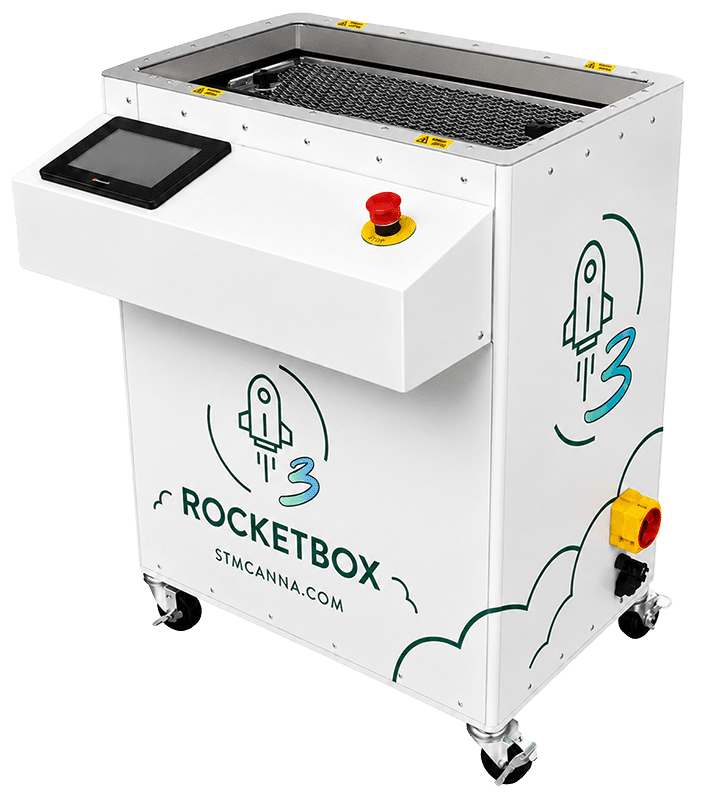
Price
$19,995
70mm
✓
84mm
✓
98mm
✓
109mm
✓
109mm+
Confirm custom size
Max Daily Volume
Up to 20,000/day
✓ = supported with the correct trays. The RocketBox 3.0 supports all four standard cone lengths. Two 143-joint or two 72-joint trays require the appropriate adapter kit. For 109mm+ oversized cones, confirm machine compatibility and specialized tray configuration with STM. Contact STM for configuration details.
The four standard commercial pre-roll cone sizes are 70mm (Dogwalker), 84mm (1¼ Classic), 98mm (98 Special), and 109mm (King Size). These four formats represent approximately 90% of pre-roll products sold in U.S. dispensaries. STM Canna machines support all four standard sizes. A fifth format, the 109mm+ oversized cone, is used for infused pre-rolls made with homogenized infused material including hashhole and live resin formats.
King size cones are the 109mm pre-roll format, the most produced cone size in U.S. commercial cannabis production. They have a 12.5mm opening diameter and hold roughly 0.75 to 1.6g of flower depending on density, with a burn time of 20 to 30 minutes. King size is the format most operators anchor their flagship SKU around because it commands the strongest price-to-value perception at retail. All STM filling machines run 109mm king size cones, and on STM equipment the 109mm tray accounts for about 70% of all tray orders. Source: STM Canna internal production data, Spokane WA.
Fill weights vary by flower density and grind consistency. General commercial ranges: 70mm holds 0.25 to 0.5g, 84mm holds 0.5 to 0.65g, 98mm holds 0.5 to 0.75g, 109mm holds 0.75 to 1.6g, and the 109mm+ infused format holds 1.0 to 2.0g or more. Two identical cones filled with different strains will hold different weights due to flower density variation. This is why commercial pre-roll machines calibrate by weight rather than by volume. Source: STM Canna manufacturer specifications, Spokane WA.
A half-gram pre-roll holds 0.5g of flower and is typically produced in the 84mm 1¼ format or the 98mm format, both of which fill comfortably in the 0.5 to 0.75g range. The 84mm at 0.5 to 0.65g is the most common half-gram retail SKU and the highest-velocity format in dispensaries. Half-gram pre-rolls sit at the price-to-quantity ratio most consumers choose for daily personal use. Source: STM Canna manufacturer specifications, Spokane WA.
The 109mm king size is the most produced pre-roll format in U.S. commercial cannabis production. STM Canna’s own production data shows 109mm is the most popular tray size ordered by customers running STM machines, accounting for 70% of all tray orders. The 84mm 1¼ is the second most produced size and the highest-velocity retail SKU by unit volume. Most successful multi-SKU catalogs combine both formats – 109mm as the flagship anchor SKU and 84mm driving trial and daily-use volume. STM Canna machines produced over 1 billion pre-rolls across these formats in 44 U.S. states. Source: STM Canna internal production data, Spokane WA.
Canoeing happens when a pre-roll burns faster down one side, leaving unburned flower. The main causes are inconsistent grind size, uneven fill density, over-grinding into powder, and inconsistent moisture content. The most effective fix is a consistent 4 to 5mm grind from a calibrated commercial grinder combined with machine filling that packs to a consistent weight. Standardizing those two variables resolves most canoeing complaints because it produces an even burn channel from tip to filter. Source: STM Canna production specifications, Spokane WA.
Choose cone size based on your target fill weight, material and finished product format. The RocketBox 3.0 fills prepared homogenized, sticky or dense infused material as well as standard flower; its published standard sizes are 70mm, 84mm, 98mm and 109mm, with custom sizes available. Infused production does not automatically require an oversized 109mm+ cone. Confirm compatibility for wider specialty cones and hashhole formats with STM before selecting trays. Filling prepared infused material is separate from adding concentrate; the Astro Infuser 2.0 is a separate infusion station. Source: STM Canna product specifications.
Flower density directly affects how much cannabis fits in a given cone volume. Fluffy, airy flower has high filling power and occupies more volume per gram. Dense, compact flower has low filling power and packs more weight per unit of volume. Two identical 98mm cones filled to the same visual level can hold 0.6g of one strain and 0.9g of another depending on density. Commercial pre-roll machines calibrate by weight to account for this. The STM LaunchPad Scale weighs 72 joints simultaneously and flags out-of-spec fills in real time. Source: STM Canna manufacturer specifications, Spokane WA.
A pre-roll cone tapers from a wide opening at the tip to a narrow filter end, while a tube keeps a uniform diameter end to end like a cigarette. Tubes produce a more consistent fill density and a constant draw from first light to finish, but cones are the dominant commercial format and run on the widest range of automation equipment. Tubes require different filling machines than tapered cones. STM machines are engineered for cone formats from 70mm to 109mm+.
The STM RocketBox Pro at $59,950 supports 70mm, 84mm, 98mm, 109mm and specialized 109mm+ configurations across five stations. The STM Mini RocketBox+ at $6,600 supports the four standard sizes up to 10,000 joints per day. The RocketBox 3.0 at $19,995 supports 70mm, 84mm, 98mm, 109mm and custom sizes for standard flower and prepared infused material, with production of up to 20,000 pre-rolls per day depending on material and workflow. Two 143-joint or two 72-joint trays require the appropriate adapter kit. Confirm exact tray, cone dimensions and any 109mm+ custom configuration with STM before ordering. STM machines are manufactured in Spokane, WA.
Wood pulp and hemp papers perform most reliably at commercial automation scale due to their structural consistency and resistance to tearing during automated fill cycles. Rice paper burns slower and more neutrally but requires tighter humidity control in the production facility. Cellulose paper is not recommended for high-volume automated production due to higher tear rates. Paper type should be confirmed with your cone supplier before committing to a format at commercial scale.
Yes. Rice paper cones burn slowly and have a nearly neutral flavor, which makes them popular for premium and terpene-forward SKUs. The tradeoff for commercial automation is that rice paper is thinner than wood pulp and requires tighter humidity control in the production facility to hold its shape consistently through an automated fill cycle. Wood pulp and hemp papers are more forgiving at high volume, but rice paper performs well when facility humidity is controlled. Source: STM Canna production specifications, Spokane WA.
A 4 to 5mm particle grind is the production standard for commercial pre-rolls that smoke consistently and burn evenly. At this particle size, ground flower maintains enough structure to allow airflow through the cone without compacting into a dense, powdery fill. Grind that is too fine – below 2 to 3mm – creates excessive draw resistance, uneven burns, and increased consumer complaints. The STM Revolution 2.0 commercial cannabis grinder is calibrated to 4 to 5mm output as its production standard. Modular grinding systems allow grind size to be set independently of fill speed, which is not possible on all-in-one machines where grind and fill are controlled by the same integrated system. Source: STM Canna production specifications, Spokane WA.
STM Canna is a commercial pre-roll equipment manufacturer based at 2701 North Van Marter Road, Spokane Valley WA 99206. STM machines have produced over 1 billion pre-rolls and are used by 50% of the top 20 U.S. pre-roll brands including STIIIZY, Verano, Cresco Labs, Curaleaf, and Cali-Blaze across 44 states and 14+ countries. Customer production examples: Lifted NW in Portland produces 23,000 joints per day on a legacy RocketBox and Atomic Closer. CaliBlaze closes over 60,000 joints per day across three states using STM Atomic Closers. Gold Services in Seattle produced 200,000 joints in 10 days on one Mini RocketBox+ and one Atomic Closer.

Free expert consultation
Tell us your cone sizes, target fill weights, and daily volume. Our team will help you choose compatible equipment and a production setup that fits your operation.
Free. No commitment. No hard sell. Just a straight answer.
Used by 50% of the top 20 U.S. pre-roll brands


