
Pre-roll manufacturing isn’t about a faster filler.
It’s about a line that stays predictable for 8 straight hours.
If you’ve ever run a “big day” and still missed the ship window, you know what I mean. You can’t brute-force your way to volume with overtime forever. At some point, the line needs structure: steady input, steady output, tight weight control, and a finish that doesn’t embarrass your brand.
Here’s what a real high-throughput pre-roll operation looks like from the inside.
Pre-roll manufacturing throughput math that actually matters
Most teams track units per hour. The best teams track units per labor hour.
Let’s say your goal is 12,000 pre-rolls per shift.
You staff 6 people across prep, filling, weighing, closing, and support.
That’s 48 labor hours in one 8-hour shift.
Now the key question: how many of those hours produce sellable units?
If your line loses 50 minutes to jams, resets, and rework, you lose about 10% of the shift. That’s 4.8 labor hours gone. At $24 per hour fully loaded, that’s $115 burned in a day, just in labor. Add missed shipments and nobody’s laughing anymore.
Relatable moment: it’s like a kitchen with a full dining room. One station falls behind and the whole place feels it.
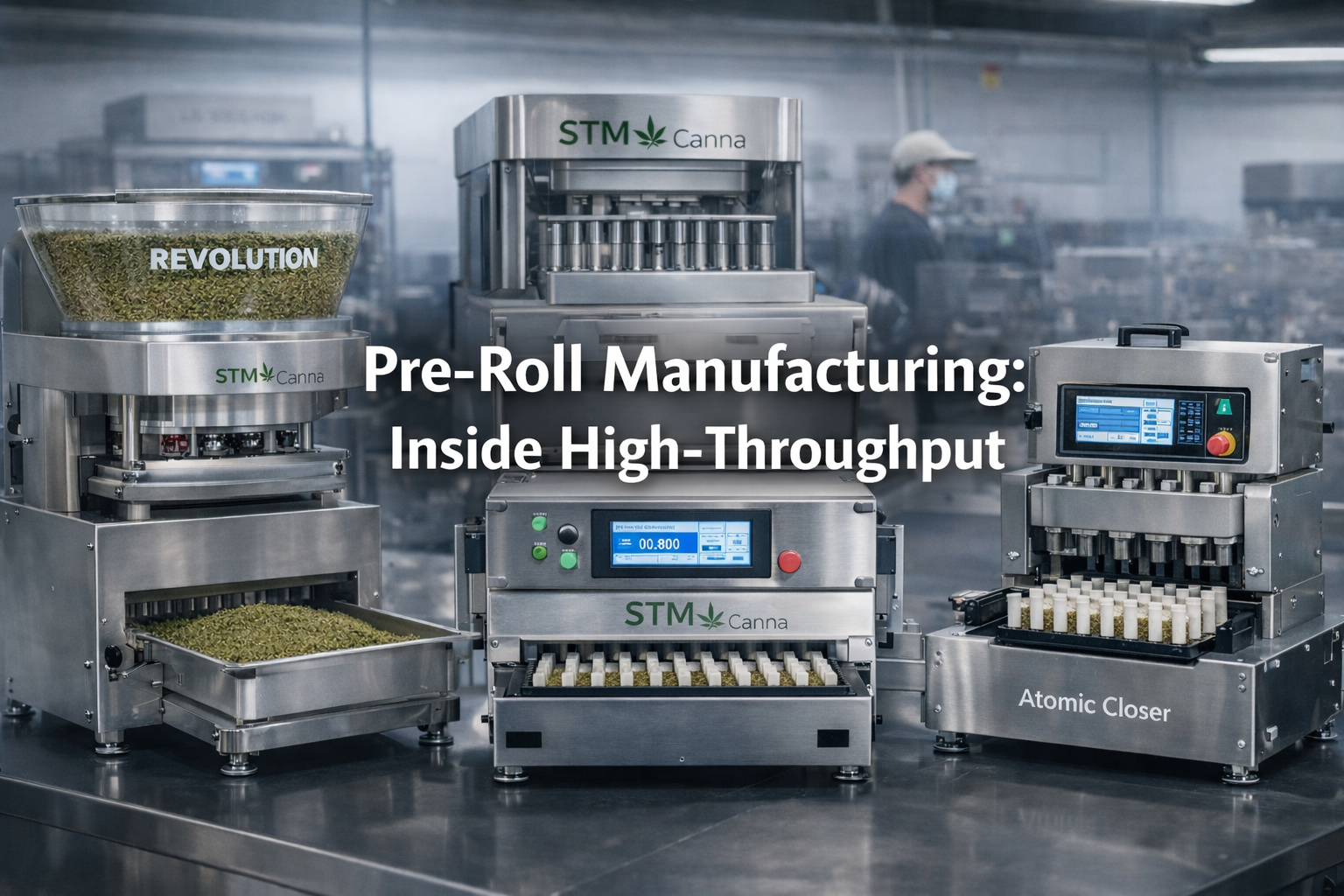
High-throughput shops design the day around flow. They set batch sizes, stage raw materials, and build a repeatable tray rhythm. STM’s equipment lineup is built around that modular tray workflow concept across grinders, fillers, weighing, and closing.
Pre-roll manufacturing material prep is where you win the day before the day starts
Everyone wants to talk about filling. The day gets decided in prep.
High-throughput manufacturing starts with a simple promise: the material hitting the filler stays consistent for the entire run. That means you plan your grind and blend like you plan your packaging inventory.
A typical production day includes at least 3 material events that can wreck consistency:
- A new lot comes out of storage
- A new operator takes over
- Moisture and grind shift after a bin sits open for 2 hours
When those shifts hit, weight drift and cone failures show up fast. Then the line starts “fixing” instead of producing.
This is where industrial grinding matters. STM’s pre-roll ecosystem includes grinders like the Revolution Grinder and Mini-Revolution, built as part of the broader pre-roll production workflow.
Relatable moment: you’ve seen it. Someone says “it’s the same strain.” The next tray runs totally different anyway.
Practical high-throughput targets many plants use in prep look like this:
- Stage 2 to 4 bins for a single SKU run
- Pre-label bins for batch ID, start time, and operator
- Keep one “active” bin and one “next” bin ready, so the filler never waits
That’s not glamorous. It saves hours.
pre-roll manufacturing filling at volume means controlling the boring stuff
At high throughput, small problems become daily problems.
A tiny cone variation becomes 200 bad units by lunch.
A loose SOP becomes a new “style” after the third shift change.
STM’s cone filling equipment family includes RocketBox 2.0, RocketBox Pro, and Mini RocketBox PLUS+, positioned for commercial and mid-scale operations that want repeatable production without jumping to ultra-expensive full automation.
High-throughput teams set rules like these:
- One cone size per run, no “just make it work”
- One target weight per run, locked before the first tray
- One operator owns adjustments, not six people taking turns
If you want a clean number to chase, chase stability. A stable line that runs at 85% of its top speed beats a line that hits 100% in short bursts and spends the rest of the day recovering.
Relatable moment: it’s like driving in traffic. The fastest car still sits in the same jam.
Pre-roll manufacturing weight control is where margins live or die
High-throughput manufacturing turns tiny overfills into real money.
Take a simple example:
- Target weight: 1.00 g
- Average overfill: 0.04 g
- Daily output: 12,000 units
- Extra material burned per day: 480 g
- At $1.10 per gram internal cost, that’s $528 per day
Run 20 days a month and that’s $10,560 in material that never shows up on an invoice.
This is why serious shops add automated weighing and check steps. STM’s ecosystem includes the LaunchPad Scale as part of the tray workflow approach.
Relatable moment: every operator has said “it’s only a little heavy.” Then finance shows up with the spreadsheet.
High-throughput plants usually set a weight discipline like this:
- Check weights every 15 to 30 minutes
- Log any adjustment with a timestamp
- Separate “start-up trays” from sellable trays until weights settle
That’s how you protect both margin and audit readiness.
Pre-roll manufacturing closing and finish quality decide repeat orders
At scale, quality isn’t a vibe. It’s a measurable rate.
If your defect rate is 1% at 12,000 units per shift, that’s 120 units. If each fix takes 25 seconds, that’s 50 minutes of labor time spent fixing what should’ve shipped clean.
Closing matters because it affects:
- Shelf look
- Burn behavior
- Customer perception in the first 3 seconds
STM offers the Atomic Closer as a dedicated closing solution within the pre-roll workflow.
Relatable moment: you can run a perfect fill all day, then one sloppy top ruins the whole tray photo.
High-throughput operators standardize finishing the same way they standardize weights:
- Define an acceptable crown look with a simple visual guide
- Train to it in 30 minutes
- Spot check 1 tray per hour for finish consistency
That’s how brands stay consistent across shifts.
Pre-roll manufacturing changeovers are the hidden bottleneck
Most lines don’t fail because they can’t run. They fail because they switch too often.
Every changeover has a cost:
- Lost time: 20 to 60 minutes
- Cleanup time: 15 to 30 minutes
- First-tray waste: 1 to 3 trays while the line settles
Do 3 changeovers in a day and you can lose 2 to 3 hours of production time. That’s a brutal hit.
High-throughput plants usually do one of two things:
- Run fewer SKUs per day and ship in waves
- Build two lines: one for core SKUs, one for “everything else”
Relatable moment: it’s like printing shirts. Switching ink colors kills your day.
STM’s modular approach helps plants build a line that fits their SKU strategy, from grinding through filling, weighing, and closing.
Pre-roll manufacturing infused runs add steps, not excuses
Infused pre-rolls drive revenue. They also add process risk.
A lot of teams learn this the hard way: infused work magnifies inconsistency. A small mixing issue becomes a big consumer complaint. A dosing mistake becomes a compliance nightmare.
STM also develops infusion automation like the ASTRO INFUSER for infused pre-roll production workflows.
High-throughput infused shops usually tighten controls like this:
- Shorter batch windows, like 45 to 90 minutes
- More frequent weight checks, like every 10 to 15 minutes
- Clear segregation of infused vs non-infused tools and trays
Relatable moment: it’s like making spicy salsa. One uneven batch and everyone knows.
Pre-roll manufacturing high throughput looks different by region
The mechanics stay the same. The pressure changes by market.
STM equipment operates in 43 US states and 13 countries, including Canada, the Netherlands, the UK, Germany, Australia, Israel, Poland, and South Africa.
What changes across regions:
- US multi-state operators: SOP portability matters. You need the same tray workflow in every facility.
- Canada: documentation and process repeatability stay front and center.
- EU and UK style programs: process story and records carry weight with partners and regulators.
- Australia and Israel: batch control and consistency expectations make rework painful.
Relatable moment: the same pre-roll can sell anywhere. The paperwork doesn’t travel as easily.
FAQs
What is high-throughput pre-roll manufacturing?
High-throughput pre-roll manufacturing is a production line designed to run full shifts with stable output, controlled weights, fast recovery from stoppages, and consistent finishing across operators.
What’s the biggest bottleneck in pre-roll production at scale?
Changeovers and rework usually limit throughput more than top speed. Teams lose 2 to 3 hours a day when they switch SKUs too often or chase weight drift.
How do I reduce pre-roll overfill at volume?
Set a weight check cadence, log adjustments, and add an automated weighing step. Even a 0.04 g average overfill can cost over $10,000 a month at 12,000 units per shift.
What equipment is typically used in a high-throughput pre-roll line?
Most high-throughput lines include industrial grinding, automated cone filling, automated weighing, and consistent closing, often built around a tray workflow. STM’s ecosystem includes Revolution Grinder, RocketBox systems, LaunchPad, Atomic Closer, and infusion automation like ASTRO INFUSER.
The next question your floor should answer today
What’s your true cost per 1,000 pre-rolls when you include downtime and overfill?
Use this simple formula on a whiteboard:
Cost per 1,000 = (labor hours per shift × blended rate + material overfill cost + rework cost) ÷ (units shipped ÷ 1,000)
If that number surprises you, your line is talking. It’s telling you where high throughput actually lives. Need help crunching the numbers? Contact us today!