Multi-state operators can’t afford inconsistency, downtime, or guesswork on their cannabis machinery floor. When pre-rolls account for 30 to 50 percent of unit sales, machinery must deliver uniform grind size, tight weight tolerances within ±0.02 grams, and thousands of flawless cones per shift without ballooning labor costs. The right equipment protects margins, stabilizes compliance across 5 to 20 active licenses, and keeps shelves stocked with product that burns evenly every single time.
MSOs don’t need entry level cannabis machinery. They need 5,000 to 20,000 pre rolled joints per shift without chaos.
Your machinery should bridge the gap between manual crews and ultra expensive fully automated systems. Professional modular systems let you scale by trays, not by gutting your facility.
If one state requires 8,000 cones per day and another needs 25,000, your equipment should expand in layers. Add capacity without replacing the whole line. That flexibility protects capital across 3 to 15 active licenses.
Speed matters. Sustainable speed matters more.
If your pre rolled joints particle size swings, burn quality swings.
MSOs processing 200 to 500 pounds per day can’t rely on entry level cannabis machinery. You need uniform pre roll output in the 1 to 2 millimeter range to prevent canoeing and tight draws.
Inconsistent grind increases reject rates by 5 to 10 percent. That compounds across states.
Industrial grinding systems like the Revolution Grinder are built for commercial pre-roll throughput, not boutique batches . When you’re feeding multiple filling machines, grind uniformity becomes your foundation.
No consistent grind. No consistent product.
These problems are solved with the Revolution 2.0 Cannabis Grinder.
Overfilling pre rolled joints 0.05 grams across 1 million units equals 50,000 grams lost.
Under filling creates compliance risk and customer distrust. MSOs operating in 10 or more regulated markets can’t afford either scenario.
Modular weighing cannabis machinery like the STM Canna LaunchPad Scale that verifies fill weight across trays keep variance tight . Holding tolerance within ±0.02 grams protects margin and reputation at the same time.
That level of control turns guesswork into math.
And math scales across states.
Standardization is everything in an MSO environment.
If Florida runs one process and Illinois runs another, consistency collapses. A tray-based cannabis machinery workflow links grinding, filling, weighing, and closing into one repeatable system .
That matters when you operate in 5, 10, or 20 facilities. SOP duplication becomes realistic. Training time drops from 4 weeks to 10 days. Cross-state audits get easier.
Uniform systems protect brand identity.
Every cone in every state should smoke the same.
Airflow resistance drives burn quality.
A 10 percent density swing can cut burn time by 3 minutes or cause relights mid-session. Customers don’t forgive that twice. Machines that fill pre rolled joints must distribute material evenly across the tray, not just fill fast. Compression consistency keeps draw resistance stable from unit to unit.
Burn complaints drop. Repeat purchases rise.
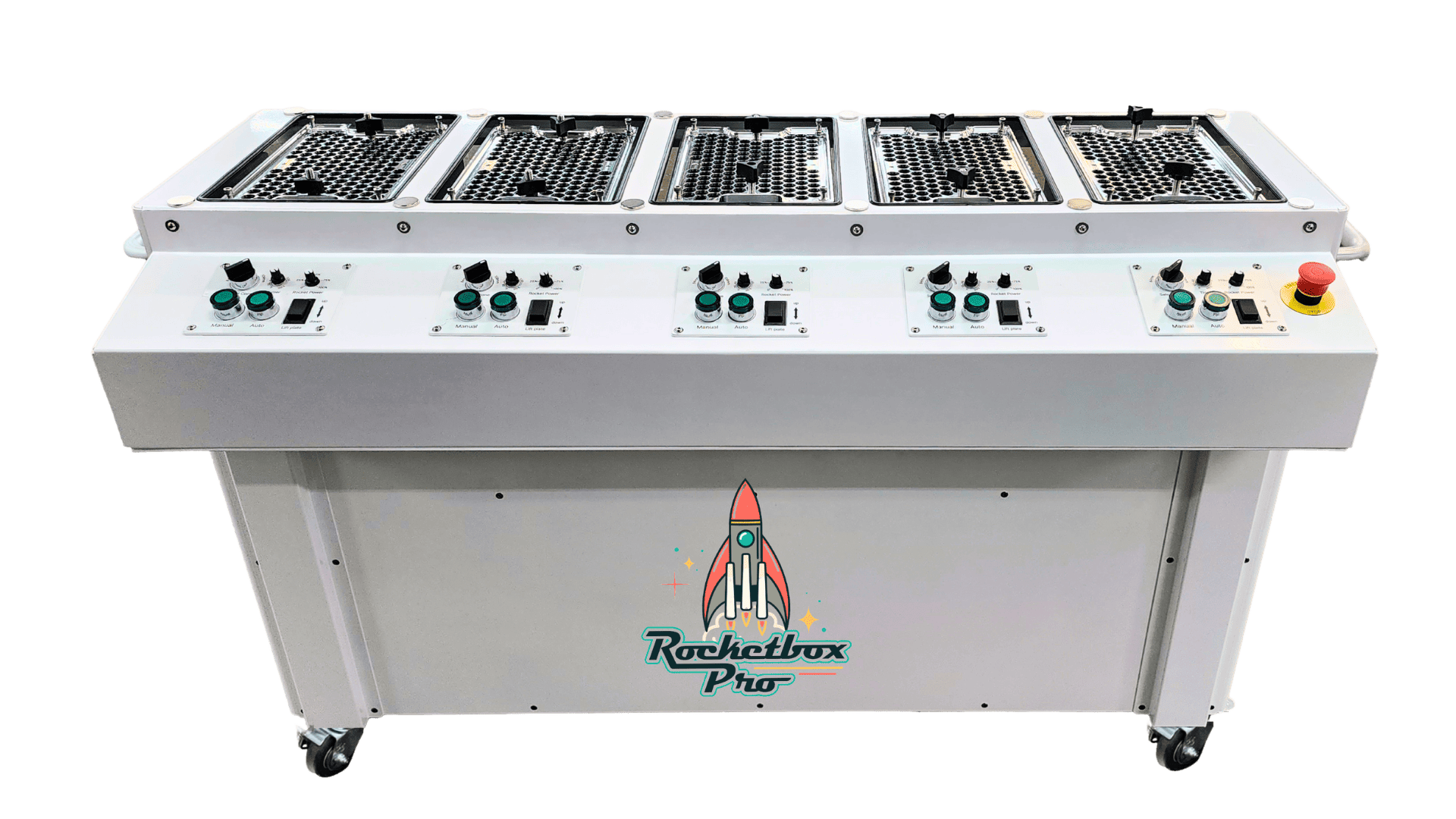
If you are a cannabis MSO looking for high end industrial pre roll cannabis machinery that you can count on day in and day out STM Canna’s RocketBox Pro is the machine for you.
Pre rolled joints with Loose twists spill in transit. Over-twisted cones clog airflow.
At 100,000 multi-packs per quarter, even a 2 percent damage rate means 2,000 compromised units. Retailers remember that.
Modular closing cannabis machinery such as the STM Canna Atomic Closer creates perfectly uniform dutch crowns. This protects product integrity during packaging, shipping, and stocking.
Customers judge appearance before they judge flavor.
Presentation drives perceived value.
Infused pre rolled joints often carry 20 to 40 percent higher retail pricing.
But infusion inconsistency destroys that premium fast. Oil clumping creates hot spots and harsh pulls. Uneven terpene application changes flavor perception.
Infusion-focused production systems such as the STM Canna Astro Infuser address distribution repeatability at commercial scale . When you’re running 5 to 15 percent concentrate inclusion, distribution must be uniform across thousands of units.
High-margin SKUs deserve production discipline.
Daily output depends on the specific machine model:
*Mini-RocketBox+: Produces up to 1,250 per hour or 10,000 per day with a small crew
*RocketBox 2.0: Produces up to 2,500 per hour or up to 20,000 per day
*RocketBox Pro: Produces up to 5,000 per hour or up to 40,000+ per day using a continuous workflow
The new 2026 Atomic Closer can crown up to 34K a day
YES. A single full-time employee hand-rolling joints costs a minimum of $28,800 per year, whereas an automated machine can speed up production by 12x or more, often delivering an ROI in just 3-6 months.
Automation eliminates the “hidden costs” of manual labor, such as production bottlenecks and inconsistent pack quality
All RocketBox models use STM’s proprietary nitrogen-filled airbag system, not mechanical tamping like KnockBox or King Kone. This creates an even, fluidizing vibration that fills cones without gaps, while the adjustable lift plate ensures proper density at the filter and volumetric metering via the top tray delivers consistent, accurate target weights.
STM machines are compatible with standard 70mm Dog Walker, 84mm (1-1/4″), 98mm (Special Small), and 109mm (King Size). Other types sizes available on request.
The Mini-RocketBox+ is up to 5× faster than the Knockbox (143 joints in <45 seconds vs. 100 joints in 2 minutes). It uses volumetric metering with no pre-weighing to automatically hit target weights, while Knockbox users often must pre-weigh material or manually fix under-filled joints.
STM’s proprietary nitrogen-filled airbag system replaces simple mechanical tamping for more consistent fills.
Built from American stainless steel and aluminum and manufactured in Spokane, WA, the Mini-RocketBox+ is domestically made—unlike the overseas-produced Knockbox.
Top brands choose modular systems to avoid downtime. If an “all-in-one” machine (like JuanaRoll) is expensive, complicated and if something breaks, the entire production line stops.
With STM’s One-Tray Workflow, stations are independent; if the filler is being cleaned, the closing and infusing stations can keep running, ensuring continuous output at a fraction of the cost.
For more details on this read the blog post Analyzing All-In-One Systems.
Demos are available on a case-by-case basis. If you would like a demo, reach out here to schedule a demo.
STM proudly leads by example in customer service, support and satisfaction.
Our highly regarded Client Success Program includes: a dedicated client portal with a range of tools, videos and support documents; a dedicated Client Services representative tasked with providing you technical assistance, virtual training, and in-depth support; and options for On-Site Training.
A One Year Parts & Labor Manufacturing Warranty is included with every machine. We design, engineer and manufacturer our equipment in-house to uphold the utmost quality. As such, new part orders would be ordered from STM directly vs. having to source 3rd party parts overseas or from external manufacturers.
If you’re rolling for personal consumption, you can purchase a pre-rolled joint already filled with ground cannabis or use an empty cone to fill and pack your joint manually. For commercial production, many dispensaries and cannabis processors prefer a pre-roll machine, such as the Mini-RocketBox for efficiency and product consistency.
Payment for all orders is due in full. We offer financing through our partner NEC. We may have other terms and plans available. Contact us.
Yes. STM has a Trade-In Quote program for customers looking to upgrade from older machines. Contact us for more information.
Labor is volatile. Turnover rates in cannabis manufacturing can exceed 40 percent annually.
The manual production of pre rolled joints may require 6 to 10 technicians per shift for 3,000 units. Modular automation can reduce that to 2 to 4 operators for higher output.
That shift cuts labor cost per unit and reduces training cycles.
Machines don’t call out sick during peak holiday demand.
They also create measurable output per hour, per tray, per operator.
MSOs need both efficiency and control.
Every state has its own inspection rhythm.
Weight accuracy, sanitary design, material traceability, and cleanable surfaces matter during audits. Equipment built with food-grade materials and domestic manufacturing standards simplifies compliance .
When inspectors walk through, your machinery should support your documentation, not complicate it.
Multi-state operators can’t risk shutdowns over preventable mechanical issues.
Compliance stability equals revenue stability.
Real estate isn’t cheap. Build-outs cost $150 to $300 per square foot in many markets.
Your pre-roll machinery must fit within existing square footage while leaving room to grow. Modular Cannabis Machinery allows for phased expansion instead of total line replacement.
Add a grinder. Add a filler. Add a weighing station.
Scale from 5,000 units per week to 50,000 without redesigning the facility.
MSOs expand fast. Machinery should keep pace.
Executives care about output per hour, reject rate, labor cost per thousand units, and yield loss.
Your machinery should provide measurable metrics, not vague estimates. If one facility runs at 92 percent tray efficiency and another runs at 81 percent, leadership needs that visibility.
Consistent equipment across states makes benchmarking possible.
That’s how MSOs identify bottlenecks, protect margins, and plan expansion capital intelligently.
Without data, growth turns into guesswork.
With the right machinery, production becomes predictable across every license you operate.
A global hip-hop and cannabis icon, Redman chose STM Canna. Watch him and NBA legend Shawn Kemp explain why.