
Plan your pre-roll production line
Choose a production setup that fits your daily demand, product format, staffing, and budget. Compare equipment in one place, then plan the complete workflow.

Explore the buying guide
The useful capacity figure is the number of saleable pre-rolls your whole line can finish in a shift. Define the job before comparing machine speed.
Use current orders, a realistic growth forecast, and the number of shifts you can staff. A larger machine only creates value when demand and the rest of the line can use its capacity.
Choose equipment around the product your retail channels want. Cone fillers and machines that roll from paper serve different formats. Check cone length, diameter, fill weight, and oversized SKUs before ordering.
Standard flower, prepared infused blends, and adding concentrate to a filled pre-roll are different production requirements. Confirm the intended process with the manufacturer and test your material.
Time preparation, loading, filling, weighing, closing, and packaging separately. A faster filler will not increase finished output if closing or packaging is already at capacity.
Compare the labor you can actually replace with the cost of a lightly used machine. An entry-level filler can make sense when demand is already moving toward sustained daily production.
Evaluate the RollCraft MRB or Mini RocketBox+ and plan a closing solution alongside the filler. Compare tray handling and future workflow compatibility as well as purchase price.
Evaluate the RocketBox 3.0 with material preparation, weighing, and closing capacity sized for your target. Confirm the tray and adapter configuration for the stations you intend to connect.
Evaluate the RocketBox Pro, multiple filling stations, or an integrated line. Test uptime, format changeovers, operator workload, and finished output under conditions that match your facility.
Compare equipment by function before comparing prices. Filling figures describe filling capacity; closing figures describe closing capacity. They are not interchangeable measures of a complete line.
| Machine | Guide price | Published capacity | Equipment type | Production fit |
|---|---|---|---|---|
| RollCraft MRB | $3,500 | Up to 10,000/day | Semi-automated filler | Craft cone production |
| RollCraft ATC | $24,995 | Up to 2,100 closings/hr | Automated closer | Craft Dutch Crown closing |
| RollCraft MRB + ATC bundle | $29,995 | Up to 10,000/day filled and closed | Separate fill + close stations | Craft production line |
| STM Mini RocketBox+ | $6,600 | Up to 10,000/day | Semi-automated filler | Growing modular workflows |
| STM RocketBox 3.0 | $19,995 | Up to 20,000/day | Semi-automated filler | Flower and prepared infused material |
| STM RocketBox Pro | $59,950 | Up to 40,000+/day | Semi-automated filler | High-volume and multiple SKU production |
| STM Atomic Closer | $59,995 | Up to 4,250 closings/hr | Automated closer | Higher-volume Dutch Crown finishing |
| King Kone | ~$2,000 | Operator-dependent | Manual cone filler | Very small runs |
| Futurola Knockbox 100 | ~$5,400 | Varies | Semi-manual cone filler | Entry-level cone filling |
| APEHEX | ~$120,000; confirm configuration | Up to 1,200/hr | Automated system | Single-system production |
| Accelerant PRO2 | Pay-per-joint; request terms | Up to 1,500/hr | Automated service model | Lower upfront equipment outlay |
| RollPros Blackbird | ~$225,000+ | ~900/hr | Automated rolling system | Straight-roll production |
| Hefestus AuraX | ~$230,000 | 2,000+/hr | Fully automated system | Enterprise integrated production |
| PreRoll-Er 200 | $275,000–$325,000 | Up to 1,300/hr | Fully automated system | Compliance-focused production |
Planning reference based on the published October 2026 guides. STM and RollCraft rows are highlighted. Competitor prices marked “~” are estimates; configurations and service terms can change. Request current manufacturer quotes. Actual throughput depends on material, moisture, cone format, staffing, and workflow.
$3,500–$6,600
The MRB and Mini RocketBox+ provide filling capacity at an accessible entry price. Add preparation, quality checks, and closing to build a working production budget.
$19,995–$59,950
RocketBox filling platforms can be paired with separate stations. The filler price is one component of the line; a dedicated closer or infuser is an additional purchase.
$120,000–$325,000
Evaluate the included functions, service model, installation requirements, and changeover process. Compare the installed production system with a complete modular configuration.
Use these profiles to narrow the shortlist, then confirm the configuration, material compatibility, and production assumptions in a demo.

$3,500
Published capacity: Up to 10,000 pre-rolls/day
A compact starting point for craft cone production. The MRB fills 72 or 143 cones per cycle using pneumatic fluidization. It suits operators who want to automate filling first and add separate finishing equipment as demand grows.
Best fit: Craft producers evaluating their first filling machine.
Plan for: Budget for closing, quality checks, material preparation, and an operator to run tray cycles.

$6,600
Published capacity: Up to 10,000 pre-rolls/day
A tabletop filling platform for small and growing production teams. Its role in a modular line is the main buying consideration: compatible trays connect filling with STM weighing, closing, and infusion equipment.
Best fit: Small to mid-volume producers planning a connected workflow.
Plan for: Compare the entire setup and tray requirements with the MRB rather than comparing filling speed alone.
$19,995
Published capacity: Up to 20,000 pre-rolls/day
A semi-automated filling platform for standard flower and prepared homogenized infused material. Particle Lock settles material without traditional tamping; FlexAir supports the built-in compressor or a facility air source.
Best fit: Growing commercial operations that need flexibility across material types.
Plan for: One 453-joint tray, two 143-joint trays, or two 72-joint trays are available configurations. Dual-tray setups require the appropriate adapter kit; confirm cone compatibility.

$59,950
Published capacity: Up to 40,000+ pre-rolls/day
A five-station filling system for higher daily output and multiple production runs. Consider it when demand, staffing, and downstream finishing capacity can support an enterprise filling platform.
Best fit: High-volume producers, co-packers, and operations running multiple SKUs.
Plan for: It remains semi-automated. Include the staffing, closing, weighing, and packaging needed to turn filling capacity into finished output.

$59,995
Published capacity: Up to 4,250 Dutch Crown closings/hour
A dedicated closing station that finishes 72 pre-rolls in approximately 28 seconds. It addresses a different bottleneck from a filler: converting filled cones into consistent Dutch Crown finished pre-rolls.
Best fit: Producers whose hand-closing capacity limits the rest of the line.
Plan for: This is a closer, not a filling machine. Size the filling and closing stations together and verify actual finished output.
Compare the RollCraft ATC at $24,995 and the MRB + ATC bundle listed at $29,995. The ATC is a dedicated Dutch Crown closer. Ask for the exact bundle contents, tray compatibility, operator requirements, and current quote before comparing the bundle with separately purchased equipment.
The purchase decision includes how the equipment behaves when you change products, need service, or add capacity.
Separate stations handle preparation, filling, weighing, closing, and infusion. This lets you invest in the bottleneck and choose capacity at each step. Plan tray compatibility and the handling between stations.
An integrated machine can connect multiple functions in one system. Evaluate format support, access for cleaning, service response, and how a module fault affects the rest of production.
A service model can reduce the upfront equipment purchase. Compare minimum volumes, per-unit fees, contract length, downtime responsibilities, and what happens if production demand changes.
Model the full cost at several production volumes alongside equipment ownership.
A facility may use different equipment for cones, straight rolls, or specialized SKUs. Compare each line against its own output requirement and include the extra training, spares, and handling involved.
Product format and operational fit should drive the configuration.
A balanced line needs more than a filling machine. Work through each stage and include loading, cleaning, changeovers, and packaging in your staffing plan.

Plan weight checks, tolerances, rejects, and the labor required for quality control.

Keep finishing capacity aligned with the filler and your preferred retail finish.
Filling a prepared infused blend is separate from adding concentrate to an individual pre-roll. Confirm your method before choosing an infuser or assuming that a filler completes the infusion step.
Use your facility’s labor and output figures to evaluate the investment. Published maximum throughput and another operator’s payback period are starting points for discussion.
Estimated payback months = total installed investment ÷ net monthly savings.
Start with labor and other operating costs you can actually remove. Subtract added costs for machine operation, service, consumables, and financing as appropriate. Keep any assumption about extra sales separate from confirmed savings.
Example: a $30,000 setup delivering $5,000 in net monthly savings has an estimated six-month payback. This is an illustrative calculation, not a production or savings guarantee.
Financing can spread the initial outlay, but compare deposits, fees, interest, term length, and total repayment. Request current eligibility and terms for the exact equipment configuration.
Check machine condition, remaining support, parts availability, calibration, tray compatibility, and any transferable warranty. Include inspection, transport, repairs, and startup downtime in the comparison.
Ask each manufacturer to show a complete run that reflects your flower, cone, fill weight, finish, and staffing plan.
The guides list craft filling equipment from $3,500, commercial STM filling platforms from $19,995 to $59,950, and integrated enterprise systems around $120,000 to $325,000. A complete production budget also includes supporting equipment and operating costs. Confirm current quotes and included configurations.
Choose by product format, sustainable daily demand, material requirements, staffing, and the step limiting finished output. Use the comparison table to build a shortlist, then test the full workflow with your material.
Yes. Operators typically load trays and material, move work between stages, and perform quality checks. Ask for the staffing and handling assumptions behind every throughput figure.
A filling machine must be designed for the material you plan to use. RocketBox 3.0 supports standard flower and prepared homogenized infused material. Adding concentrate to a pre-roll is a separate process; confirm the intended infusion method and any additional equipment.
Compare the complete installed system, format flexibility, service procedures, staffing, and maintenance impact. Modular stations and integrated machines involve different tradeoffs; the best fit depends on your operation and product mix.
Explore the original blog resources when you want more detail on pricing or individual machine reviews.
Explore budget tiers, labor costs, ownership considerations, and the assumptions behind payback calculations.
Read the longer machine-by-machine assessments, strengths, considerations, and production examples.
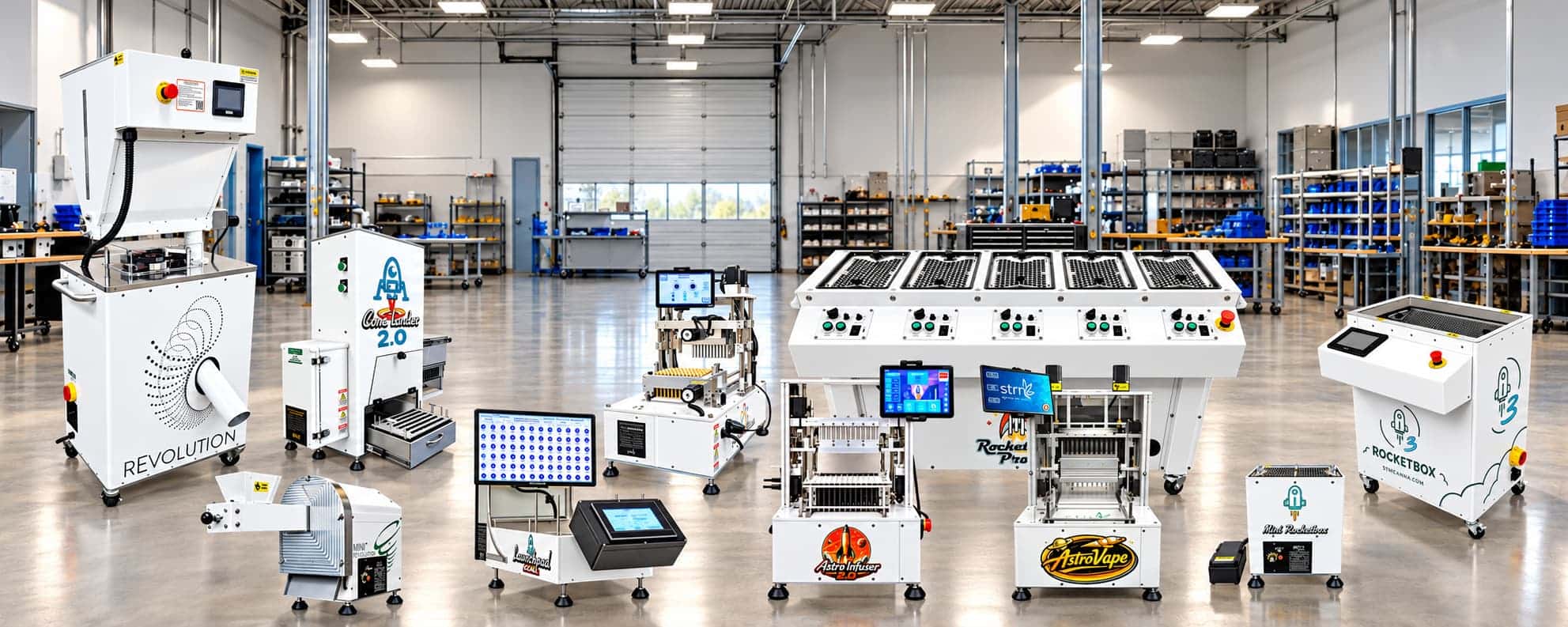
Bring your daily volume, product formats, material requirements, and budget. STM’s team can help compare configurations and plan a demo around your operation.


