
Pre-roll demand feels simple until your line hits reality. One day, you’re fine with a few thousand cones a week. Then a buyer asks for 30,000 units by Friday, in three strains, with tight weight limits. Your team starts hand-packing late, your weights drift, and suddenly half the shift turns into rework.
A pre-roll system that grows with you does one thing well. It keeps the same tray moving from grind to fill to weigh to close, without your staff doing hero work to make the numbers happen.
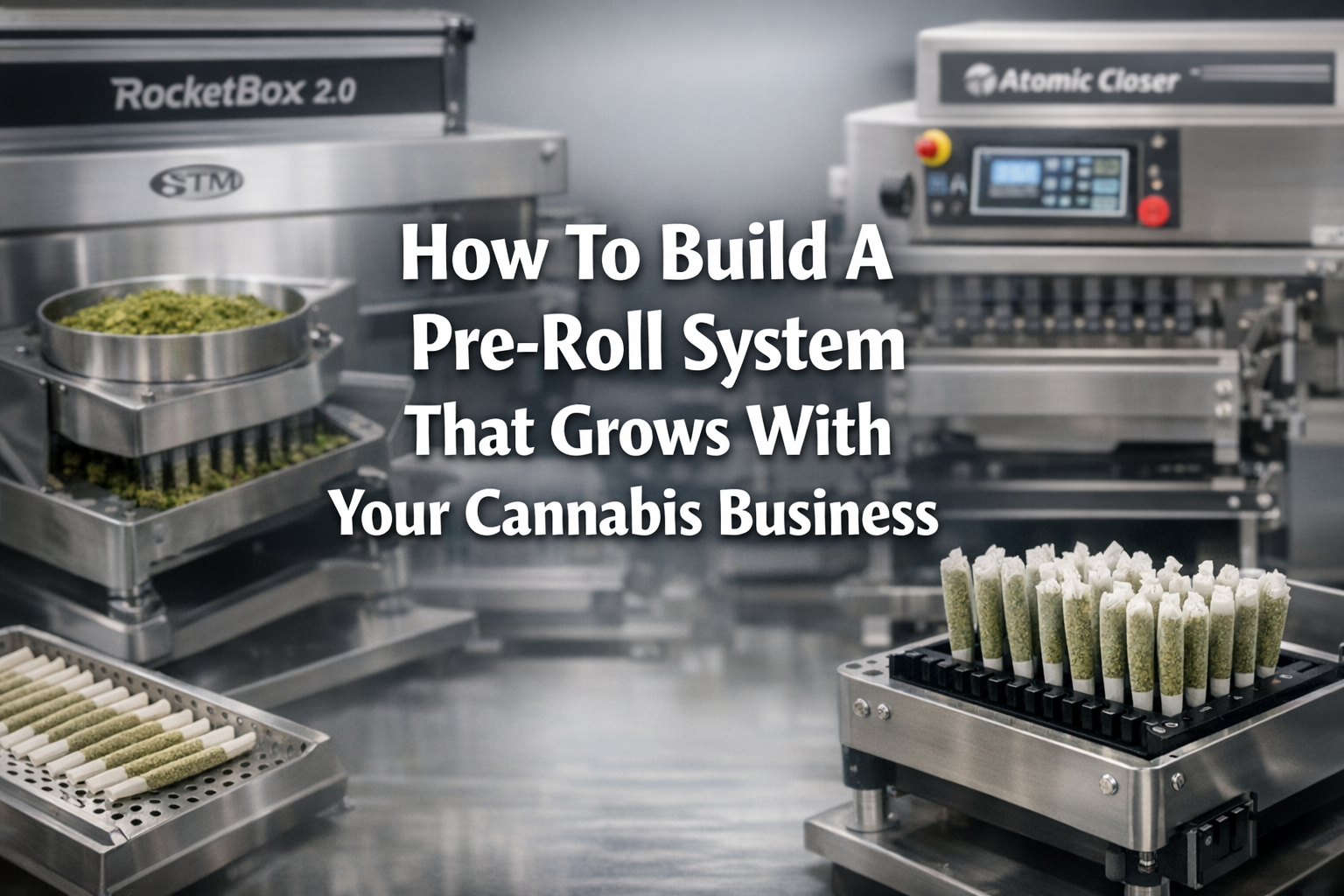
STM Canna builds gear around that exact idea: a modular, single-tray workflow with dedicated machines for grinding, filling, weighing, and closing.
Start with your cannabis business workflow, not the machine
Most pre-roll “systems” fail because they start with the filler and ignore everything around it.
Here’s the common picture. You grind in one room. You fill in another. You weigh by hand on a bench scale. You close at the end, when people are tired. Every handoff adds small mistakes. Those mistakes stack.
If you want a line that scales, build it like a production line, not a craft station.
A simple tray workflow looks like this:
- Grind to spec
- Fill and pack on trays
- Checkweigh the tray
- Close the tray
- Pack-out
That’s it. No fancy talk. Just fewer touchpoints and fewer chances for drift.
STM’s product lineup is built to run this way, with the Revolution Grinder, RocketBox family, LaunchPad Scale, and Atomic Closer as core stations in the same tray-based flow.
Fix the grind step first, or your filler waits
Grinding sets the tone for everything downstream.
If your grind swings from fluffy to sandy, your pack density swings too. You can blame the filler all day, but the filler just reacts to what you feed it. Then you get cones that feel tight, cones that feel loose, and weights that creep.
This is why teams put an industrial grinder at the front of the line. STM’s Revolution 2.0 sits in that role as the “feed the line” station.
Here’s a real way to look at the cost. Say your line targets 1,200 pre-rolls per hour across a shift. If the grinder clogs or backs up and you lose 20 minutes twice a day, that’s 40 minutes gone daily. Over a 5-day week, that’s 200 minutes, or 3.3 hours of filler time you already paid for.
You don’t feel it as “3.3 hours.” You feel it as late orders, overtime, and a pack room that’s always behind.
Keep the grinder steady and your whole line stops feeling fragile.
Pick the right filler for today’s volume, then plan the next jump
This is where most operators get burned. They buy a machine for the volume they want, not the volume they run right now. Then they drown in changeovers, training, and unused capacity.
STM’s filler lineup gives you a clean path: start smaller, then scale without tossing your process.
You’ll hear teams talk about three phases:
Phase 1: You need to stop hand-packing
This is when you’re filling cones by hand, weights drift, and you keep rebuilding trays. Your output depends on who showed up that day.
Phase 2: You need repeatable trays
Now you care about consistent pack feel and speed. You want the tray to move like clockwork.
Phase 3: You need real production horsepower
Now you’re feeding multiple POs, multiple strains, and you can’t afford your line to pause because one SKU got weird.
STM’s RocketBox platform lives in Phase 2 and Phase 3, with machines like RocketBox 2.0, RocketBox Pro, and the Mini RocketBox Plus named as core products in the modular system.
A quick ROI snapshot helps here.
Let’s say hand-packing takes 6 staff on a shift at $18 per hour. That’s $108 per hour in labor just on packing, before a supervisor touches anything. Run 2 shifts for 5 days and you spend:
- $108/hour × 16 hours/day × 5 days = $8,640 per week
- That’s $449,280 per year if you run 52 weeks
Even if automation cuts only 3 people off that station, that’s $224,640 per year back into margin or growth.
The point is not the exact number. The point is that labor is the biggest lever in pre-roll, and the filler station sets the pace.
Add a checkweigh step before problems reach packaging
Most teams “checkweigh” too late.
They weigh a few samples at the start of the day. They weigh again when a supervisor walks by. Then they find out weights drifted after the cones are already closed, labeled, and boxed.
That’s the expensive kind of mistake.
A tray-based checkweigh step fixes this fast. STM’s LaunchPad Scale is built as an automated weighing system inside the same tray workflow.
Think about what checkweigh protects:
- Compliance: weights stay inside your posted tolerance
- Brand trust: customers stop getting “light” units
- Labor: fewer cones get pulled back for rework
Here’s a simple rework math example.
If you run 10,000 pre-rolls per day and 2% fall outside your target, that’s 200 pre-rolls to fix. If rework takes 30 seconds each, that’s 100 minutes of labor daily. Over a month of 22 production days, that’s 2,200 minutes, or 36.7 hours.
That’s almost a full work week spent fixing product that already ran once.
Checkweigh the tray while it’s still easy to correct. Your team stays calmer, too. Nobody likes finding problems at the end of the line.
Closing is its own station, not an afterthought
Closing is where pre-rolls get ruined.
You can run a clean fill and still lose money if your close step bends tips, cracks paper, or creates loose tops that fail your drop test. People rush. They over-twist. They crush cones. Then you see rejects show up in QC.
That’s why closing should be a dedicated station with a repeatable motion.
STM includes the Atomic Closer as part of the same single-tray workflow system, right alongside filling and weighing.
Here’s the part operators rarely admit out loud. A “manual close team” looks cheap until turnover hits. When your best closer quits, quality drops the next day. Automation keeps the close consistent, even when staffing changes.
One short example from real life: a pack room lead once told me, “My best closer went on vacation and my reject bin doubled.” That’s not a people problem. That’s a system problem.
Build your cannabis business pre-roll system in modules so you can grow without ripping it out
Growth hurts when your equipment forces a full reset.
You switch cone sizes and everything breaks. You add a second shift and your grind step can’t keep up. You land an infused SKU and your workflow becomes a spaghetti mess.
A modular system prevents that.
STM’s approach is built around equipment that works together in a single tray workflow, and that matters because it lets you scale station by station instead of gambling on one giant machine purchase.
Here’s what scaling looks like in the real world:
- Add a second filler station when demand jumps
- Add checkweigh modules as your SKU count grows
- Add dedicated closing when rejects start creeping
- Add infusion automation when infused becomes a real percentage of revenue
That’s how you keep production stable while sales pushes harder.
Quick FAQ for cannabis business operators and buyers
What is a pre-roll system?
A pre-roll system is the connected set of stations that take flower from grind to finished joint, using the same tray workflow so each step feeds the next. STM designs its equipment to work together in that modular flow.
What order should I automate first?
Start where your line stalls the most. For many teams, that’s grind consistency and filling speed. Next, add checkweigh, then closing.
How do I estimate the labor savings?
Use this quick formula:
Weekly labor cost on one station = headcount × wage × hours per day × days per week
Then compare it to the headcount you keep after automation.
The next step: calculate your real capacity gap
Grab three numbers from your own floor:
- Your target pre-rolls per day
- Your current finished pre-rolls per day
- Your rework percentage
Then run this:
Real output = finished units − (finished units × rework %)
If that “real output” number falls short of demand, your next question isn’t which machine looks cool.
The next question is which station is slowing the tray right now.