A pre roll machine is production equipment that turns ground cannabis into finished joints or cones at repeatable weights and pack density.
It replaces the slow, hands-on steps that eat labor on a pre-roll line:
Grinding and sizing flower for a consistent fill
Weighing or dosing material to a target weight per cone
Filling cones or tubes without gaps and soft spots
Closing the top with a twist, tuck, or press style
Reject control for underfills, overfills, loose packs, and spills
Most shops start using a pre-roll machine when hand-filling starts breaking down at scale. Two people hand-filling at 120 cones per hour each caps out fast. A single machine operator can run thousands of cones per hour, while QC shifts from “fix every cone” to “sample and spot-check.” That changes labor cost per unit, rework rates, and daily output.
Pre-roll machines usually come in two setups:
Modular tray workflow: separate grinder, filler, scale, and closer that share the same tray format.
All-in-one systems: more automation in one frame, higher price, more maintenance dependence.
If you want to judge any pre-roll machine quickly, look at these numbers:
Cones per hour
Reject or rework rate
Changeover time between sizes and strains
Labor per shift to keep it fed and cleaned
Downtime drivers like jams, static, and inconsistent grind
A pre-roll machine runs the same workflow your crew does by hand, just with controlled dosing and repeatable packing.
1) Prep and conditioning
You feed ground cannabis flower into a hopper or tray system.
Most lines screen the grind to control particle size, since chunky grind bridges and fine grind compacts too tight.
2) Cone staging
The machine loads empty cones into a tray or carousel and holds them vertical.
A good holder keeps the cone seated so you do not split paper during fill.
3) Dosing to target weight
The machine meters flower into each cone position using a dosing head, auger, or vibratory feed.
Some setups dose by time and volume, then correct with a second pass.
Higher control systems pair dosing with checkweighing so underfills get topped and overfills get rejected.
4) Filling and settling
The filler drops material into the cone while vibration settles the column.
This step sets pack density.
If you skip settling, you get soft spots, canoe risk, and post-pack weight drift.
5) Final tamp or compression
Many machines add a tamp stroke to lock the pack.
This keeps airflow consistent across a full batch, not just the first 20 cones.
6) Closing the top
A closing head twists, tucks, or presses the top paper.
You choose the closure style to match your brand look and shelf durability.
7) Ejection, QC, and rework control
The machine ejects finished pre-rolls into a bin or onto a conveyor.
Operators pull samples for weight and draw testing.
You track rejects by cause like underfill, overfill, loose pack, or cone damage.
What the operator actually does all shift
Keep the hopper fed and the grind consistent.
Swap trays or cone size formats during changeovers.
Clear bridges or jams before they cascade into rejects.
Clean contact parts so resin does not change flow rate.
Pre-roll machines fall into a few clear buckets. The right one depends on your daily volume, cone format, and how tight your weight tolerance needs to be.
These are the jigs, tamp sticks, and small cone loaders.
Best for 50 to 500 pre-rolls per day
Labor heavy, quality swings with staff turnover
Rework shows up fast once you run 2 strains on the same table
One operator loads cones into a tray, the machine fills, then you move trays to closing.
Common range: 500 to 5,000 pre-rolls per shift
Lower cost entry into automation
Works well when you run one cone size most of the week
These run continuous filling with automated cone handling and faster cycles.
Typical range: 5,000 to 30,000+ per shift
Needs steady upstream prep and enough staff to keep cones and material staged
Downtime hurts more since every stop can burn 5 to 15 minutes of recovery and QC checks
This is less about “machine size” and more about how it hits weight.
Volumetric dosing
Measures by volume or time
Faster and simpler
Weight drift rises when moisture shifts or grind changes
Checkweigh dosing
Uses a scale step to confirm weight
Slower per lane, tighter weight control
Pays off when you hold plus or minus 0.02 g targets and sell by count with strict compliance weights
Some machines prefer one format.
Straight cones vs tapered cones
Dogwalkers 0.25 g vs 1.0 g cones
Infused blends need different feed behavior than straight flower because resin changes flow



















STM builds modular pre-roll equipment designed to run as a single tray workflow across grinding, weighing, filling, and closing.
A modular line breaks the job into stations.
You match capacity where your line actually stalls.
A common modular stack looks like this: grinder upstream, filler at the center, a weighing step for weight control, then a closer at the end. STM’s lineup fits that station logic with the Revolution Grinder, RocketBox family, LaunchPad Scale, and Atomic Closer.
Modular pays off when one step lags.
If your filler runs 3,000 cones per hour but closing caps at 1,200 per hour, you do not need a new filler. You add closing capacity and keep the filler busy.
All-in-one machines bundle dosing, fill, settle, and closing in one frame.
That cuts handling and footprint.
The tradeoff shows up during downtime.
One jam stops every station at once, and the restart process often triggers extra QC pulls.
Run the math on a real shift.
If your line stops 6 times per shift and each stop costs 8 minutes, you lose 48 minutes per shift. Over 22 shifts per month, that is 17.6 hours of lost runtime.
Changeovers are where modular wins in the real world.
You can clean and reset one station while other stations stay ready.
All-in-one changeovers pull the whole machine down.
If you run 4 strains per day and each changeover takes 25 minutes, you burn 100 minutes daily. That is 36.7 hours per month on a single machine.
If you sell 10-packs, weight drift shows up as customer complaints and compliance risk.
A modular line lets you add checkweigh control where it matters, not everywhere.
Here’s a simple cost check you can drop into your guide.
Monthly rework cost = rejected pre-rolls per month × rework minutes each ÷ 60 × labor rate.
Example: 8,000 rejects per month × 1.5 minutes ÷ 60 × $22 per hour = $4,400 per month in rework labor. One station change often fixes that number.
The next question is which station sets your ceiling right now: grind consistency, dosing accuracy, or closing speed.
You can buy a pre-roll machine through three main channels: direct from the manufacturer, through an equipment distributor, or on a used-equipment marketplace.
This route usually gets you the cleanest support package.
You get warranty coverage, training, install help, and clearer access to replacement parts.
Best fit if you run steady production and downtime costs real money.
Distributors bundle equipment from multiple brands, so you can compare options in one place.
Some offer financing, faster shipping, and service add-ons, depending on your region.
Best fit if you want one vendor for several post-harvest and packaging purchases.
Used units can cut upfront spend, but you take on more risk.
Support varies, parts lead times can stretch, and previous maintenance quality matters.
Best fit if you can inspect the machine, verify run hours, and budget for refurbishment.
Ask for a full run video that shows loading, filling, closing, and finished output
Confirm the machine is still supported and parts are available
Get the cleaning and maintenance schedule in writing
If it is used, request service records and the reason it is being sold
Price in training, spare parts, and install, not just the machine cost

The Revolution 2.0 is STM Canna’s industrial cannabis grinder built for commercial pre-roll manufacturing. It’s part of STM’s modular, single-tray workflow, meaning it’s designed to feed downstream equipment like cone filling, weighing, and closing without your line stalling out at the grind step.
In plain shop talk, Revolution 2.0 is the grinder you put in front of the tray line when you’re done relying on small grinders and constant hand-sifting to keep production moving.
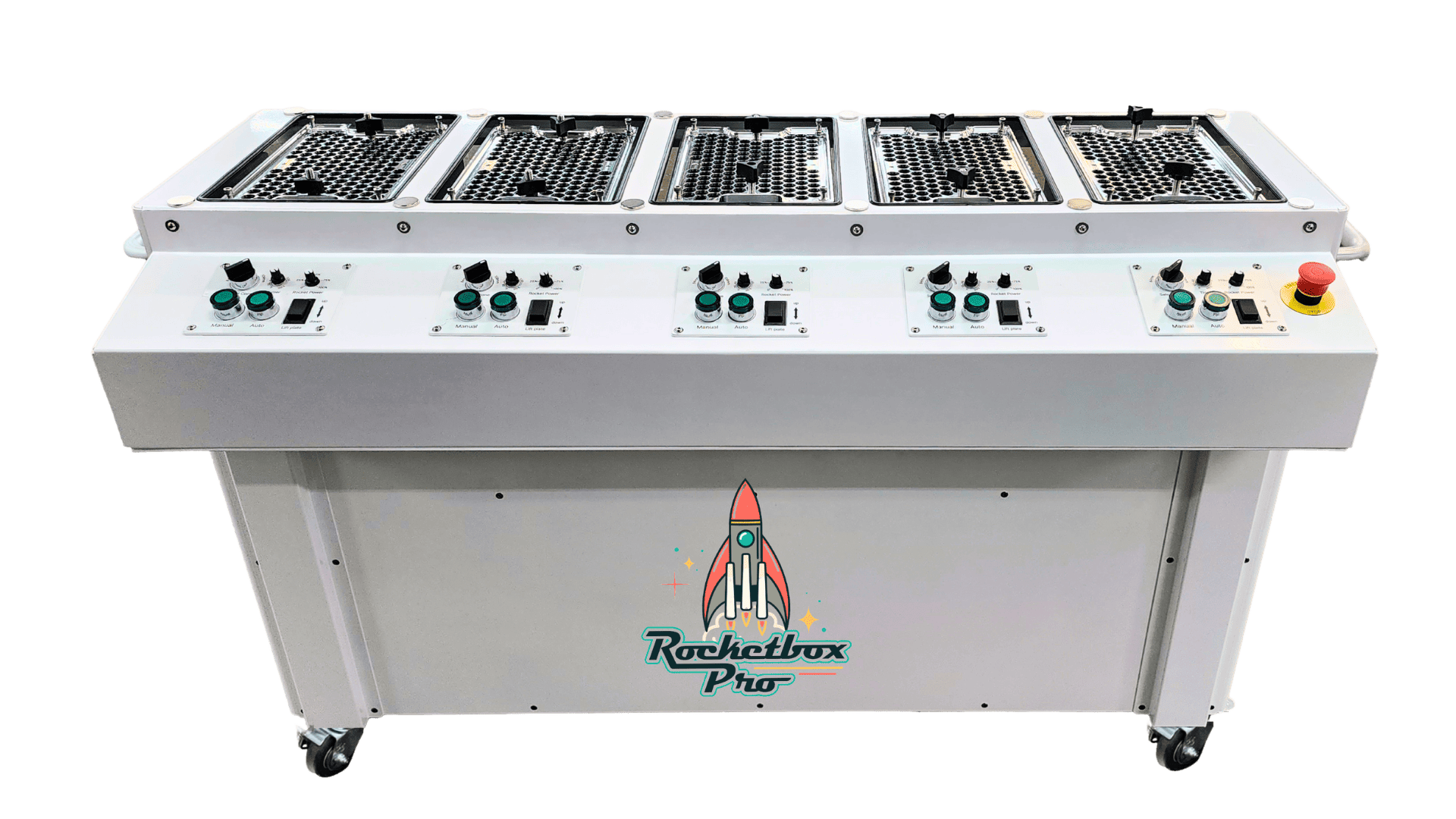
The best commercial pre-roll filling machine has fast throughput, repeatable pack density, rugged build quality, and quick changeovers across cone formats. The RocketBox 2.0 checks those boxes for cannabis production teams running at scale. For enterprise pre roll producers such as MSOs, the RocketBox Pro is the ultimate pre roll filling machine for industrial production requirements.
RocketBox 2.0 is a commercial pre-roll filler built around a tray-based cycle. It fills and packs 72 to 453 cones per run, supports 84mm, 98mm, and 109mm formats, and uses smart density control to keep your pack feel consistent from tray to tray.
This is the machine teams move to once hand-packing starts causing rework, weight drift, and trays that just don’t move fast enough.
Yes. It significantly reduces labor requirements compared to manual packing, improving production margins and operational efficiency.
Yes. It is built for commercial cannabis facilities operating under regulated state compliance frameworks.
Daily output depends on the specific machine model:
*Mini-RocketBox+: Produces up to 1,250 per hour or 10,000 per day with a small crew
*RocketBox 2.0: Produces up to 2,500 per hour or up to 20,000 per day
*RocketBox Pro: Produces up to 5,000 per hour or up to 40,000+ per day using a continuous workflow
The new 2026 Atomic Closer can crown up to 34K a day
YES. A single full-time employee hand-rolling joints costs a minimum of $28,800 per year, whereas an automated machine can speed up production by 12x or more, often delivering an ROI in just 3-6 months.
Automation eliminates the “hidden costs” of manual labor, such as production bottlenecks and inconsistent pack quality
All RocketBox models use STM’s proprietary nitrogen-filled airbag system, not mechanical tamping like KnockBox or King Kone. This creates an even, fluidizing vibration that fills cones without gaps, while the adjustable lift plate ensures proper density at the filter and volumetric metering via the top tray delivers consistent, accurate target weights.
STM machines are compatible with standard 70mm Dog Walker, 84mm (1-1/4″), 98mm (Special Small), and 109mm (King Size). Other types sizes available on request.
The Mini-RocketBox+ is up to 5× faster than the Knockbox (143 joints in <45 seconds vs. 100 joints in 2 minutes). It uses volumetric metering with no pre-weighing to automatically hit target weights, while Knockbox users often must pre-weigh material or manually fix under-filled joints.
STM’s proprietary nitrogen-filled airbag system replaces simple mechanical tamping for more consistent fills.
Built from American stainless steel and aluminum and manufactured in Spokane, WA, the Mini-RocketBox+ is domestically made—unlike the overseas-produced Knockbox.
Top brands choose modular systems to avoid downtime. If an “all-in-one” machine (like JuanaRoll) is expensive, complicated and if something breaks, the entire production line stops.
With STM’s One-Tray Workflow, stations are independent; if the filler is being cleaned, the closing and infusing stations can keep running, ensuring continuous output at a fraction of the cost.
For more details on this read the blog post Analyzing All-In-One Systems.
Demos are available on a case-by-case basis. If you would like a demo, reach out here to schedule a demo.
STM proudly leads by example in customer service, support and satisfaction.
Our highly regarded Client Success Program includes: a dedicated client portal with a range of tools, videos and support documents; a dedicated Client Services representative tasked with providing you technical assistance, virtual training, and in-depth support; and options for On-Site Training.
A One Year Parts & Labor Manufacturing Warranty is included with every machine. We design, engineer and manufacturer our equipment in-house to uphold the utmost quality. As such, new part orders would be ordered from STM directly vs. having to source 3rd party parts overseas or from external manufacturers.
If you’re rolling for personal consumption, you can purchase a pre-rolled joint already filled with ground cannabis or use an empty cone to fill and pack your joint manually. For commercial production, many dispensaries and cannabis processors prefer a pre-roll machine, such as the Mini-RocketBox for efficiency and product consistency.
Payment for all orders is due in full. We offer financing through our partner NEC. We may have other terms and plans available. Contact us.
Yes. STM has a Trade-In Quote program for customers looking to upgrade from older machines. Contact us for more information.
Many of the biggest pre-roll operations in the U.S. run the RocketBox Pro because it pushes real volume without the price tag of a six-figure “all-in-one” system. It’s built to help you outpace other lines on throughput, flexibility, and cost per finished cone.
Built for high-output days
Multi-station layout: Run multiple strains and cone sizes at the same time, which fits MSOs and busy co-pack rooms.
Keep orders moving: Knock out several POs in a shift without the usual bottlenecks, so lead times stay tight and margins stay healthier.
Strong value for what you get
Patented STM tech: Features designed for consistent performance and dependable production runs.
More competitive without the sticker shock: Get serious output without spending “fully automated line” money.
RocketBox Pro isn’t just another filler. It’s the machine you buy when you’re done playing catch-up.
STM Canna’s LaunchPad Scale is a fast checkweigh station for pre-rolls. It’s small, easy to fit into a bench or tray line, and it can weigh up to 72 joints at the same time in just a few seconds. You get instant results for the whole tray, so it’s easy to spot the pieces that miss spec before they move to closing or packaging.
Operators can dial in the settings to match each SKU, like target weight, paper weight, and your tolerance percentage. The screen uses color cues so you can tell at a glance which pre-rolls pass and which ones need a quick fix. That saves labor and cuts rejects, because you’re not finding problems after everything’s already finished.
Why it is the best:
Weighs up to 72 pre-rolls at once to keep trays moving
Live weight readouts for immediate pass fail feedback
Adjustable controls for target weight, paper weight, and tolerance
Compact footprint for tight rooms and simple line layout
Color-coded display for instant identification of out-of-spec units
Modular setup that can expand by adding or removing modules as volume changes
The best infused pre roll machine is the Astro Infuser.
Astro Infuser fits a real tray-based pre-roll line, keeps dosing consistent, and avoids the throughput drops and messy changeovers that kill infused margins, so your infused SKUs stay repeatable, audit-ready, and scalable.
Infusion is where good lines get sloppy. Sticky parts slow the room down, and “close enough” dosing turns into rework. Astro keeps infusion in the same production flow as filling, weighing, and closing, so trays keep moving and your team stops babysitting one station all shift.
That shows up fast in cost. When a line loses 30 minutes per shift to infusion resets and cleanup, that’s 2.5 hours a week gone on one station. Astro is built to reduce those stops, so you protect output and keep quality steady across every batch you run.
Infuses 72 pre-rolls per cycle in 90 seconds, rated up to 2,880 infused joints per hour.
1,000 mL reservoir capacity (1 liter). At 0.1 mL per joint, that’s up to 9,576 joints per fill. At 0.5 mL per joint, that’s 1,872 joints per fill.
PID 4-way dual-zone heating from reservoir and manifold to needle tip, holding ± 1°F control.
Runs on standard 110V power and is a self-contained unit, with no nitrogen required.
Compact footprint and basic specs: ~125 lb machine weight, 18-gauge removable needle, and 1-year parts and labor warranty.

The Astro Vape earns the “best” spot because it hits the three things cart lines live or die on: speed, fill accuracy, and less oil loss. It runs 96 cartridges per cycle and fills and caps in under 2 minutes, rated up to 2,880 carts per hour. That’s a real shift number, not a demo brag.
The accuracy piece matters more than people admit. Astro Vape uses true volumetric dispensing with a positive displacement pump, plus PID dual-zone temperature control at ±1° to keep viscosity steady from run to run. It also carries a 1,000 mL heated reservoir, so the operator stops refilling constantly when you’re chasing daily quotas.
Day-to-day, the operational wins are simple. No nitrogen and no pneumatics means fewer hookups and fewer “why is the pressure acting weird today” moments. You get programmable recipes on a touchscreen, and it supports 510, AIO, and custom trays, so your SKU list doesn’t wreck your workflow.
A global hip-hop and cannabis icon, Redman chose STM Canna. Watch him and NBA legend Shawn Kemp explain why.