

Pre-roll lines don’t “lose money” in big dramatic ways. They bleed.
You feel it as a 12-minute jam. A tray that needs rework. A batch that fails weight checks and turns into a 2-hour cleanup project.
If your crew costs $22 per hour and 3 people touch filling, one bad hour costs about $66. Now do that 5 times per week and you’re staring at $17,160 per year in labor that didn’t ship product.
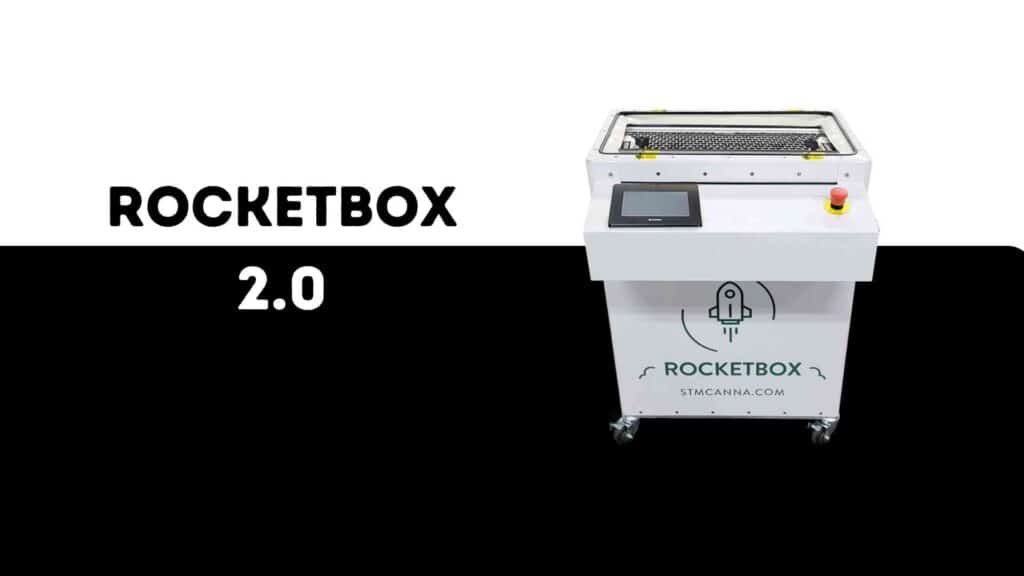
The RocketBox 2.0 exists for one job. Fill cones fast and consistently inside a tray workflow, so your team stops fighting variability and starts shipping finished units.
STM builds modular pre-roll production equipment that runs as a tray-based system, alongside grinders, weighing, and closing tools. That workflow focus matters when you scale past 500 to 2,000 pre-rolls per shift and compliance starts asking sharper questions.
Below is the practical “operator-style” way to run the RocketBox 2.0 day-to-day.
What you need before you start a RocketBox 2.0 shift
Before anyone touches cones, set the line up like you expect an audit at 2:15 pm. Because that’s usually when they walk in.
Here’s the baseline checklist I like.
1) Your inputs
- Cones for the day’s run. Stage 2 to 4 hours of cones at once.
- Ground material that matches your spec. If you’re filling 0.5g, don’t grind like you’re packing 1.2g.
- A labeled, dated bin system for “in spec” and “needs rework.”
2) Your team
- One operator owns the RocketBox 2.0.
- One floater handles trays, labels, and “simple saves.”
- If you add a third person, put them on QC sampling, not “helping fill.” That’s where you catch drift early.
3) Your targets
Pick targets that match your sellable product, not your ego.
- Weight target per cone: example 0.5g or 1.0g
- Acceptable variance: example ±0.03g
- Sample rate: 1 cone per 10, then 1 per 25 once stable
That sampling plan saves you from the classic “everything was fine until the last 400 units” situation.
RocketBox 2.0 Setup and first run: win the first 15 minutes
Most lines live or die in the first 15 minutes. The fix is simple. Run a short setup cycle with measured checks.
Step 1: Stage trays and cones
Load your cones into trays the same way every time. Consistency beats speed here.
If your tray loading changes, your fill results change. It’s annoying, but it’s true.
Step 2: Confirm your material condition
You want material that flows. If your grind is sticky, damp, or full of long fibers, you’ll see:
- bridging
- cone tops that look empty
- “surprise lightweights”
A practical target: if you pinch a small amount, it should break apart in 1 to 2 seconds, not clump into a ball.
Step 3: Run a short test
Do a test run with 20 cones.
- Weigh 10
- Record results in your batch sheet
- Adjust your process before you run full trays
Treat those 20 cones like the first pancake. Nobody serves the first pancake.
Step 4: Lock your settings for the batch
Once your weights hit target, don’t let operators “tweak for fun.” Drift starts with tiny changes that feel harmless.
If you must adjust, log it. “Adjusted at 10:40 am due to density change.” Auditors love that sentence.
Dialing in consistency on the RocketBox 2.0: density, not speed, pays the bills
The RocketBox 2.0 is a filling machine. Your real product is consistent density.
Density drives three things that hit your margin:
- how many cones pass QC the first time
- how many cones get reworked
- how often your closer has issues downstream
Here’s how to think about it.
Use a simple density score
Pick 3 cones every 30 minutes.
- Weigh them
- Tap each one 3 times
- Re-weigh
If weight drops more than 0.02g, your fill isn’t settled. That shows up later as loose cones, canoe burns, and customer complaints.
Watch for “material drift”
Material changes during the day.
- Temperature changes
- Bin compaction changes
- A new tote gets dumped in
- Someone swaps a grind screen upstream
Every change shows up as weight drift. Your sampling plan catches it early, before you have 600 units in “needs rework.”
A quick metaphor that fits
Running pre-roll filling is like running a pizza shop on Friday night.
You can throw dough faster, but if the oven temp shifts, you still burn half the pies. The fix isn’t faster hands. It’s stable process.
RocketBox 2.0 Changeovers: how to switch strains without losing an hour
Changeovers are where shops lose the most money, because labor stacks up and nothing ships.
A clean changeover target for a tray-based line is 20 to 35 minutes. If you’re taking 60 to 90 minutes, you’re paying double for the same output.
Here’s the changeover flow that keeps you sane.
1) Hard stop and isolate
- Finish the last tray
- Label it
- Move it to a finished rack
No “one more tray” after changeover starts. That’s how you mix lots.
2) Purge and remove residuals
Your goal is to prevent cross-strain contamination.
- Remove loose material
- Clear contact areas
- Wipe down surfaces your material touches
3) Run a short “first article” check
Start the new strain with 10 cones.
- Weigh all 10
- Log results
- Only then ramp up
That “first article” step saves you from scrapping 200 cones because the new strain flows differently.
Cleaning and compliance for the RocketBox 2.0 : make it easy to prove what you did
Cleaning isn’t only sanitation. In cannabis, cleaning is documentation.
If your SOP says you clean every shift, your batch record should show:
- start time
- end time
- who did it
- sign-off
A clean documentation habit can shave 30 minutes off audit stress because you stop searching for proof.
Here’s the practical routine.
End-of-shift cleaning routine
- 10 minutes: remove visible material, clear corners
- 10 minutes: wipe contact surfaces and bins
- 5 minutes: floors and surrounding work area
- 5 minutes: log and sign
That’s 30 minutes that protects a day’s output.
If you skip it, you pay later with sticky buildup, jams, and the dreaded “why does this tray fill weird now” mystery.
RocketBox 2.0 Troubleshooting: the 6 problems that slow every filling line
Every pre-roll shop sees the same problems. The best teams fix them in 3 minutes, not 30.
1) Lightweights spike
Common cause: material flow changed mid-run
Fix: pause, mix material, run 10 cone test, re-lock
2) Heavyweights spike
Common cause: over-settled material or overfill behavior
Fix: check density score, adjust process, re-test 10
3) Jams and bridging
Common cause: grind inconsistency, fibrous material
Fix: correct grind upstream, don’t fight it at the filler
4) Rework pile grows
Common cause: no sampling plan, drift goes unnoticed
Fix: sample 1 per 10 until stable, then 1 per 25
5) Downstream closer issues
Common cause: inconsistent top fill height
Fix: tighten your first-article checks and density score
6) Operator-to-operator differences
Common cause: “tribal knowledge” instead of a locked SOP
Fix: write the settings and checks into a 1-page shift card
That shift card alone can cut training time from 2 weeks down to 3 days.
RocketBox 2.0 FAQs: fast answers people search for
How do you use the STM Canna RocketBox 2.0?
Load cones into trays consistently, run a 20-cone test, weigh 10, lock your process, then sample throughout the shift.
How long should setup take?
A stable first run takes about 15 minutes if your material is ready and trays are staged.
How do you avoid rework with a pre-roll filling machine?
Use a sampling plan. Start at 1 cone per 10, then move to 1 per 25 once weights stay stable.
What’s the fastest way to handle strain changeovers?
Treat changeovers like lot control. Hard stop, purge, clean, then do a 10-cone first article check.
What should you log for compliance?
Weights, adjustments, changeovers, and cleaning start and end times. Add initials and a supervisor sign-off.
The next question you should ask
If your line hits target weight, what does your cost per 1,000 filled cones look like?
Here’s the simple formula:
Cost per 1,000 = (labor hours × hourly loaded wage) + rework time cost + scrap cost
Run that number for last week. Then run it again after you tighten sampling and cut changeovers to 35 minutes.
That gap is where your margin lives.